

Contents
- 1. At a Glance
- 2. Introduction
- 3. What Is HIPAA-Compliant Website Development?
- 4. Why HIPAA Compliance Matters for Healthcare Websites
- 5. 7 Essential Elements of HIPAA-Compliant Website Development
- 6. HIPAA Compliance vs. Website Security: What's the Difference?
- 7. Common HIPAA Compliance Mistakes Healthcare Websites Should Avoid
- 8. How to Build a HIPAA-Compliant Healthcare Website
- 9. HIPAA-Compliant Website Development for Clinics vs. Hospitals
- 10. HIPAA, Accessibility, and SEO Should Work Together
- 11. Why Work With a Healthcare Website Development Specialist?
- 12. Build a Better Digital Experience for Your Healthcare Organization
- 13. FAQs
At a Glance
- Secure technology: use HTTPS, encryption and other means to protect patient information
Proper handling and storage of data: collect, transmit, store and use the information securely and responsibly. - Access controls: software and hardware measures should be taken to ensure that only authorized users can access the data
- Third-party vendors: evaluate their use and contracts (BAAs) if any integration with their platforms is necessary.
Maintenance: keep the software updated and secure by regularly performing updates, monitoring, backups, and other operations.
In addition to the aforementioned aspects of security, it is also necessary to implement HIPAA-compliant policies and procedures, maintenance routines, risk analyses, and organizational safeguards. HIPAA-compliant software solutions should also be user-friendly and easy to use, as well as helpful in SEO, increasing performance, and maintaining a positive image.
Introduction
Healthcare websites house some of the most sensitive information that people share online. From patient contact information and appointment requests to general health and PHI (Protected Health Information), there are a lot of measures that providers need to take in order to be compliant and assure patients that their data is safe.
HIPAA compliant website development plays a vital role in the day to day operations of clinics, hospitals, medical practices, and other healthcare related organizations operating in the United States.
However, HIPAA compliance entails more than having an SSL certificate and a privacy policy page on your website.
Developing a secure healthcare website is a far more involved process of HIPAA-compliant website development that takes into account the technology, database, third party vendors, access control, forms, co-location, and other tools that you use.
In this guide, we’ll take a closer look at HIPAA-compliant website development and discuss the components that you need to consider while developing a healthcare website.
We’ll also cover the features that healthcare websites need, the common mistakes that organizations make, and the ways in which clinics and hospitals can ensure that their websites remain fully compliant and secure.
What Is HIPAA-Compliant Website Development?
HIPAA (the Health Insurance Portability and Accountability Act of 1996) establishes standards for protecting health information and regulating how covered entities and their business associates handle protected health information (PHI). For a healthcare business, this act applies if the website collects, stores, transmits, or exchanges any patient health data or connects to systems that can do so.
Thus, such a site processes personal health information in one way or another through the following means:
- Appointment request forms
- Patient registration
- Contact forms with personal details
- Patient portals
- Prescription request forms
- Insurance information
- Telehealth services
- Online payment portals
- Healthcare CRM
- EHR or other relevant software
When developing a website under HIPAA, special attention should be paid to the privacy and security aspects, as well as the appropriate handling of PHI. It is essential to understand that HIPAA compliance is not a characteristic of the website but a condition that must be fulfilled by the organization maintaining the site. In this regard, HIPAA-compliant website development refers to the specific procedures for developing the site and its software infrastructure.
Why HIPAA Compliance Matters for Healthcare Websites
Patients will expect healthcare organizations to safeguard their personal information.
A website that looks outdated, insecure, and does not care about the safety of information can ruin an organization’s credibility.
By implementing appropriate security measures, healthcare organizations can ensure
- Protection of sensitive patient information
- Reduction of possible security breaches
- Generation of trust
- Fulfillment of regulatory requirements
- Enhancement of digital patient experience
- Secure exchange of information with websites
- Development of effective data-handling procedures
Therefore, websites’ security is a matter of concern for clinics and hospitals.
7 Essential Elements of HIPAA-Compliant Website Development
There is no specific checklist of requirements that will make every healthcare website HIPAA compliant. The requirements may vary depending on how an organization works and what information its website handles
However, there are several technical and operational areas that demand special attention:
1. Protect Your Healthcare Website With HTTPS
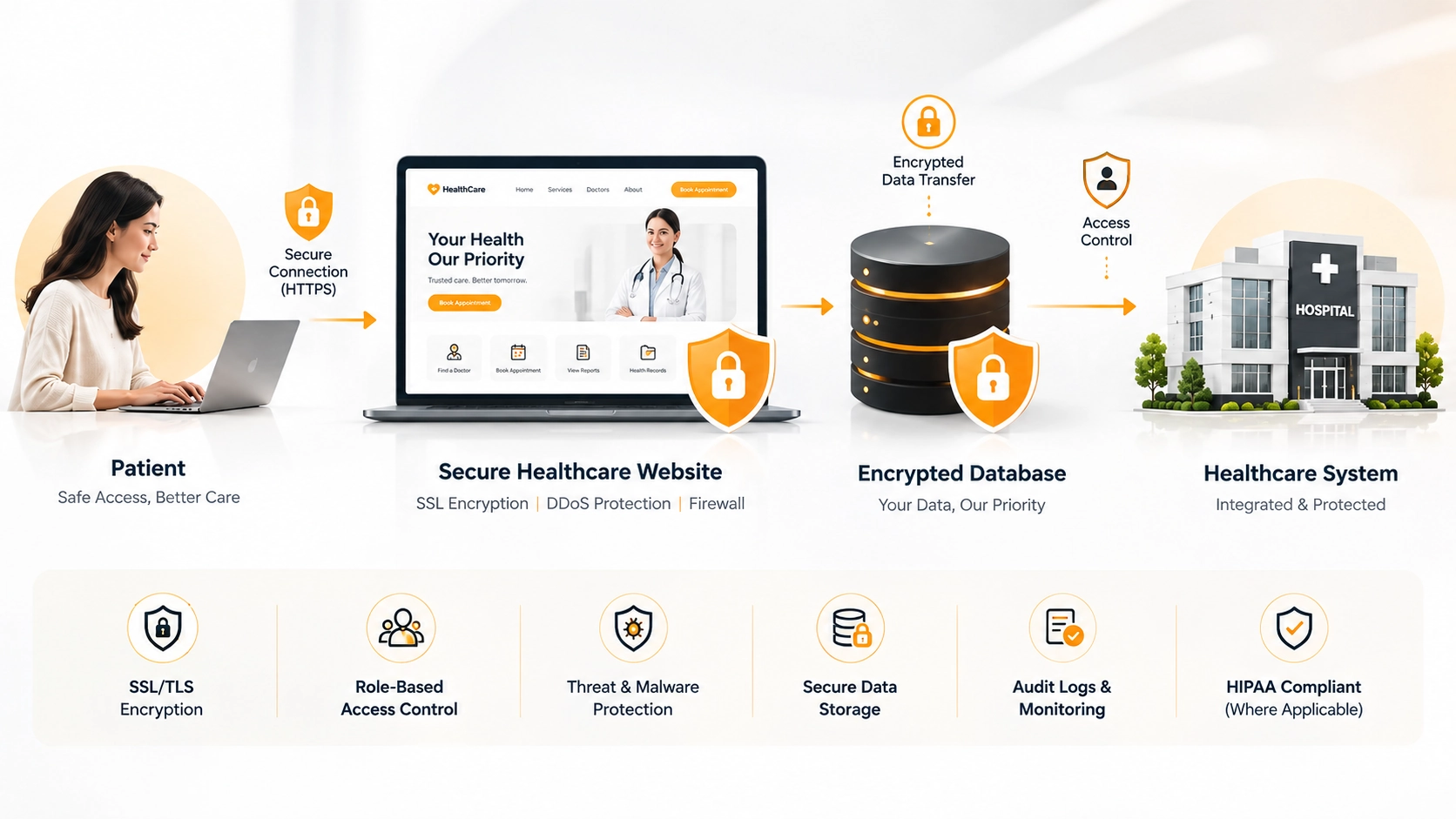
HTTPS plays a critical role in establishing a secure connection between a patient and the healthcare website. It helps ensure that the information transmitted from a user’s browser to the website server is encrypted.
An SSL/TLS certificate is a fundamental security control for any website and significantly mitigates information exposure risks over networks.
However, while HTTPS is an essential element of a healthcare website security architecture, it is not sufficient to achieve HIPAA compliance on its own.
2. Secure Healthcare Forms
Website forms present several privacy and security challenges for healthcare organizations.
While a basic contact form is generally safe to use, collecting sensitive or protected health information (PHI) over a form requires careful analysis and additional security measures.
When dealing with sensitive information, healthcare organizations must consider the relevant security technologies and protocols.
The fundamental rule is: do not request sensitive patient information using a tool unless you fully understand how this information will be handled.
3. Secure Hosting and Infrastructure
The way a healthcare website is hosted also presents several security-related considerations.
When a healthcare organization’s infrastructure involves sensitive information, the hosting infrastructure must also be evaluated according to HIPAA requirements.
Depending on the technology architecture, considerations may include:
- Server security
- Encrypted connections
- Access controls
- Backup procedures
- Website monitoring
- Logging and auditing
- Vulnerability management
- Disaster recovery
- Data retention
- Vendor agreements
A secure hosting environment is especially important for websites with patient portals, EHR systems, databases, or other healthcare-specific applications.
4. Strong Authentication and Access Controls
Healthcare websites and applications must implement strong authentication and access control mechanisms to ensure that only the right people can see or handle sensitive information.
Depending on the system architecture, access control mechanisms may include:
- Strong password policies
- Multi-factor authentication
- Role-based access
- Account administration
- Secure session management
- Limited administrative access
Secure storage of secret information
For example, a marketer may not have the same degree of access as a healthcare administrator managing sensitive patient systems.
In general, the principle of least privilege must be used when designing access control policies to minimize the risk of unauthorized access to PHI.
5. Secure Third-Party Integrations
Modern healthcare websites use several third-party applications and services.
- Appointment management systems
- Patient communication tools
- Analytics
- CRM platforms
- Payment processors
- Email services
- Chat APIs
- Telehealth applications
- EHR systems
Third-party integrations represent additional privacy and security considerations for healthcare websites.
Before connecting a service to a healthcare website, it is essential to understand what information about patients or customers will be shared with the third party and how this information will be handled.
Whenever an organization is working with a HIPAA-covered entity, the Business Associate Agreement (BAA) must be in place.
Finally, keep in mind that a popular service is not necessarily HIPAA-compliant.
Healthcare organizations should analyze every potential integration from a security perspective and consult legal or compliance professionals if needed.
6. Data Encryption and Secure Storage
Sensitive information must be encrypted during transmission and, where applicable, when stored.
Encryption is vital in most modern healthcare website security architectures since encrypted data is significantly more difficult to access and misuse.
Healthcare website development must consider encryption in context, including website connections, databases, backups, APIs, file storage, internal system communication, and other relevant factors.
Depending on the infrastructure, encryption must also be considered for data in transit and at rest.
7. Security Monitoring, Updates, and Maintenance
Finally, a healthcare website security architecture should also be considered in the context of Ongoing Maintenance.
A website is rarely secure right after launch, and most healthcare sites require regular monitoring and maintenance to ensure that everything continues to work as intended.
A healthcare organization’s website depends on many software components that require occasional maintenance, including:
- Software and plugin updates
- Security patching
- Vulnerability scanning
- User access reviews
- Backup validation
- Ongoing security monitoring and assessment
- Management of third-party dependencies
- Log monitoring and incident response
In many cases, a website that was secure when launched can become insecure over time due to inadequate maintenance and updates.
That is why it is essential to think about website maintenance when developing a healthcare website strategy.
HIPAA Compliance vs. Website Security: What's the Difference?
Website security and HIPAA compliance are closely related but not the same.
Website security covers the measures necessary to ensure the website, system, and information protection.
HIPAA compliance, in its turn, covers a wider context and includes administrative, physical, and technical safeguards and organizational aspects related to the use of protected health information.
For example, a company can be compliant in terms of website security by installing an SSL certificate, but it does not mean that all organizational and technical aspects related to PHI are considered and covered.
Similarly, having secure hosting can be insufficient in terms of HIPAA due to the necessity to address additional issues, including access control, maintenance, risk management, documentation, vendors, training, and response mechanisms.
This distinction is essential because companies should not treat HIPAA as something exclusively connected to website security.
Common HIPAA Compliance Mistakes Healthcare Websites Should Avoid
Health care organizations can make privacy and security mistakes on their website that seem easy to avoid.
Below are several examples of such errors.
Asking Too Many Questions
Do not collect more personal information from patients than needed. Just because a web form asks for it, it does not mean that health care organizations have to provide that information.
Leaving Administrative Accounts Unsecured
Administrative accounts offer extensive control over a web presence and the resources and data it contains.
Not Updating
The CMS, plugins, libraries, and other tools that power a website frequently receive critical security updates. The same is true for the tools that websites use to provide functionality such as payment processing or chatbots. Security monitoring and regular maintenance are essential.
Using Non-Standard Communication Channels
Using third-party tools is a common practice in website development. Schedule systems, chatbots, analytics services, and contact forms are often hosted on third-party platforms, which means that patient data may leave the organization’s domain. It is important to understand what information third-party software collects about website visitors.
Not Using Backups
Backups are essential for all website operators since technical issues, human errors, and security problems can cause data loss. In addition, backups must also be protected.

How to Build a HIPAA-Compliant Healthcare Website
Step 1: Identify the data you need to handle
Determine what information your website collects, processes, stores, or transmits to others.
Check whether the information exchanged falls under theHIPAA definition of Protected Health Information (PHI).
Step 2: Determine data flow
Establish the information flow by determining what information is sent to whom and how after the patients submit forms or perform other actions on the site.
An example of such a chain isPatient -> Website -> Form Provider -> Database -> Healthcare System .
You might want to start with a simple flow and iterate from there.
Step 3: Pick the right technologies
Select a CMS, hosting, form processing tools, APIs, databases, integrations, and other technologies according to your project’s needs.
Avoid being tempted to go with cheaper or more well-known solutions without considering your specific requirements.
Step 4: Review third parties
Research and compile a list of third-party organizations that have access to PHI and/or process it on your behalf.
Where relevant, make sure BAA contracts are in place.
Step 5: Set up necessary security measures
Implement the required security controls for the chosen CMS and hosting provider for your website.
- Set up all the relevant security headers for your web application.
- Create proper permission schemes and user roles.
- Encrypt PHI both on the website and in the database if needed.
- Set up backups, monitoring, and other security-related measures.
Step 6: Test everything
Make sure everything works correctly by testing your website, forms, logics, authentication and permissions, integrations, security, accessibility, mobile layout, and performance.
Step 7: Set up maintenance procedures
Review procedures for maintaining and updating the website, its security software, CMS, hosting, databases, permissions, and monitoring system.
HIPAA-Compliant Website Development for Clinics vs. Hospitals
The requirements, complexity, and scale of a healthcare website differ considerably depending on the type of organization.
Clinics and Medical Practices
A small clinic’s website will typically be relatively simple, only requiring a few essential features:
- Booking
- Doctor profiles
- Service pages
- Contact forms
- Patient portal
- Location information
- Insurance details
- Local SEO
While less feature-packed than larger healthcare providers’ sites, this level of healthcare website still requires substantial security and privacy considerations.
Hospitals and Healthcare Networks
A hospital’s website, on the other hand, is invariably substantially more complex. It often involves:
- Several locations
- An extensive database of physicians
- Advanced search options
- Internal patient portal
- EHR systems
- Appointment scheduling
- Numerous departments
- Careers page
- Content-heavy design
- Multilingual support
- Accessibility compliance
These factors make hospital/healthcare network websites development a highly involved process requiring the coordination of multiple departments.
HIPAA, Accessibility, and SEO Should Work Together
Security is not the only factor that needs to be taken into account when creating a website for the healthcare segment.
In addition to security, such sites need to be developed in a way that makes them highly accessible, SEO-friendly, and optimized for a positive UX.
For instance:
- Security allows keeping the medical information of patients safe and sound.
- Accessibility makes the site easier to use for all types of users.
- SEO adds relevant keywords to make it easier to find quality information online.
- UX design makes sure the website is easy to navigate and interact with.
- Performance makes sure that the website loads quickly and correctly on all devices.
The abovementioned aspects cannot be disregarded or approached in isolation since only the integrated strategy to the healthcare website development will yield high-quality results. Thus, if you need more information on the topic, we invite you to read our blog article entitled 7 Must-Have Features Every Healthcare Website Needs in 2026.
Moreover, you may want to learn more about our Healthcare Website Design & Development Services and how our healthcare website development services can support your organization in successfully launching its online presence.
Why Work With a Healthcare Website Development Specialist?
Healthcare website development entails more than just creating an attractive design.
Your website may need to balance:
- Patient experience
- Privacy
- Security
- Accessibility
- SEO
- Performance,
- Integrations
- Compliance considerations and
- business objectives.
Collaborating with a team that possesses a deep understanding of all the above points will enable resolving most common issues at an early stage. We specialize in Websites for Healthcare sector, delivering professional appearance, usability-first design, top performance, SEO-friendly coding, and secure development.
Build a Better Digital Experience for Your Healthcare Organization
A healthcare website should instill confidence from patients in their first interaction
Whether it is a new clinic website, hospital website redesign, or the addition of new digital healthcare services, HIPAA compliant website development has to be considered from day one.
HIPAA-compliant website development is a complex process that involves technology, procedures, security measures, vendors, and maintenance. Clinics and hospitals can create a secure and trustworthy digital experience for their patients by taking a proactive approach to development. This will improve access to care, increase convenience, and raise the overall quality of the healthcare service provided.
FAQs
A website is not made compliant by one factor. It is determined by the activities of the organization. How protected health information is collected, transmitted, stored, accessed, and managed plays a role, as well as technical, policies and procedures, vendor relationships, and other requirements.
HTTPS is only one aspect of protection, which is related to the transmission of information. There can be a number of other technical, administrative, and organizational safeguards related to HIPAA compliance.
Yes, but the healthcare organization should assess the information collected, sent, stored, accessed, and managed. Is the technology and vendor arrangement appropriate for the type of information being handled.
Not necessarily, but patient portals can be helpful to patients by providing them secure access to certain aspects of their care. The functionality and necessity can vary depending on the organization’s care and systems.
There can be a number of considerations for third-party healthcare website integrations. Each vendor should be taken into consideration; if a vendor is handling PHI on behalf of a covered entity, applicable HIPAA business associate considerations should be taken.
Healthcare organizations should work to maintain appropriate processes and security, rather than focusing solely on one-time website reviews. Ongoing maintenance, access reviews, vulnerability scans, and website backups can contribute to an appropriate level of security.
There can be a variety of costs that are dependent on a number of factors related to the website. The size and function of the website, portal requirements, security requirements, content, design, and maintenance can contribute to the cost, among other considerations. A small clinic website and a large hospital website will require very different amounts of development resources.
A web development agency can focus on the technical and website development aspects, but there are additional requirements to HIPAA compliance besides the development of a website. Healthcare organizations should work with compliance, legal, security, and other appropriate professionals to assess their environment and requirements.
A web development agency can implement security-conscious technical practices, but HIPAA compliance is broader than website development. Healthcare organizations should involve appropriate compliance, legal, security, and IT professionals to evaluate their complete environment and obligations.
Look for appropriate experience, security-conscious development, accessibility, SEO, performance, integration options, responsive design, and maintenance. The development company should be aware that there is more to HIPAA compliance than an SSL certificate.

