

Contents
- 1. At a Glance
- 2. Introduction
- 3. What Is HIPAA-Compliant Website Development?
- 4. Why HIPAA Compliance Matters for Healthcare Websites
- 5. 7 Essential Elements of HIPAA-Compliant Website Development
- 6. HIPAA Compliance vs. Website Security: What's the Difference?
- 7. Common HIPAA Compliance Mistakes Healthcare Websites Should Avoid
- 8. How to Build a HIPAA-Compliant Healthcare Website
- 9. HIPAA-Compliant Website Development for Clinics vs. Hospitals
- 10. HIPAA, Accessibility, and SEO Should Work Together
- 11. HIPAA-Compliant Website Development Checklist
- 12. Why Work With a Healthcare Website Development Specialist?
- 13. Build a Better Digital Experience for Your Healthcare Organization
- 14. FAQs
At a Glance
- Secure Technology – Use HTTPS, encryption, secure authentication, and appropriate technical safeguards to protect sensitive healthcare information.
- Proper Data Handling – Collect, transmit, store, and manage patient information through systems designed for the type of data being handled.
- Access Controls – Limit access to sensitive information based on user roles, responsibilities, and legitimate business needs.
- Third-Party Vendors – Review external platforms and integrations carefully, including applicable Business Associate Agreement (BAA) requirements.
- Ongoing Maintenance – Keep the website, software, plugins, integrations, and security controls updated and regularly monitored.
- Policies and Procedures – HIPAA considerations extend beyond technology and may include organizational processes, risk assessments, documentation, and workforce practices.
Introduction
Healthcare websites handle information that deserves a higher level of care than the average business website. A simple appointment form can collect a patient’s name, contact details, and information about the care they are seeking. More advanced websites may connect with patient portals, healthcare software, electronic health records, payment systems, or telehealth platforms.
That is why HIPAA-compliant website development needs to be considered from the beginning of a healthcare website project rather than added as a final step.
HIPAA, or the Health Insurance Portability and Accountability Act, establishes requirements for protecting certain health information handled by covered entities and their business associates. The exact requirements depend on the organization, the information involved, and the systems used.
Importantly, HIPAA compliance is not achieved simply by installing an SSL certificate or publishing a privacy policy. A healthcare website may involve hosting, databases, forms, third-party services, user accounts, APIs, backups, and internal processes, all of which may need to be assessed.
In this guide, we’ll look at the major areas to consider when developing a HIPAA-focused healthcare website, common mistakes to avoid, and practical steps clinics and hospitals can take to build a more secure digital environment.
What Is HIPAA-Compliant Website Development?
HIPAA-compliant website development refers to the technical and organizational approach used when a healthcare organization operates in an environment where HIPAA requirements apply.
HIPAA establishes standards for protecting certain health information and regulating how covered entities and their business associates handle protected health information (PHI).
A healthcare website or connected system may potentially handle information through:
- Appointment request forms
- Patient registration
- Contact forms
- Patient portals
- Prescription requests
- Insurance information
- Telehealth services
- Online payment systems
- Healthcare CRM platforms
- EHR or other healthcare software
The important distinction is that HIPAA compliance is not simply a feature of a website. It involves the broader environment in which the organization collects, uses, stores, accesses, and shares protected health information.
Website development is one part of that environment.
For example, a secure website can still create problems if a third-party form provider, analytics service, hosting environment, database, or communication platform handles sensitive information without appropriate controls.
This is why HIPAA considerations should be included during planning, development, testing, launch, and ongoing maintenance.
Why HIPAA Compliance Matters for Healthcare Websites
Patients expect healthcare organizations to treat their personal information responsibly.
A website that appears outdated, poorly maintained, or careless with sensitive information can affect how visitors perceive the organization. More importantly, inappropriate handling of protected health information can create privacy and security risks.
A properly planned healthcare website can support:
- Protection of sensitive patient information
- Reduced exposure to security risks
- Greater confidence in digital services
- Appropriate regulatory processes
- Better digital patient experiences
- Safer information exchange
- More structured data-handling procedures
Security should therefore be considered part of the healthcare website strategy, not just a technical issue for developers.
The source material similarly emphasizes that healthcare website security involves both technology and broader organizational considerations.
7 Essential Elements of HIPAA-Compliant Website Development
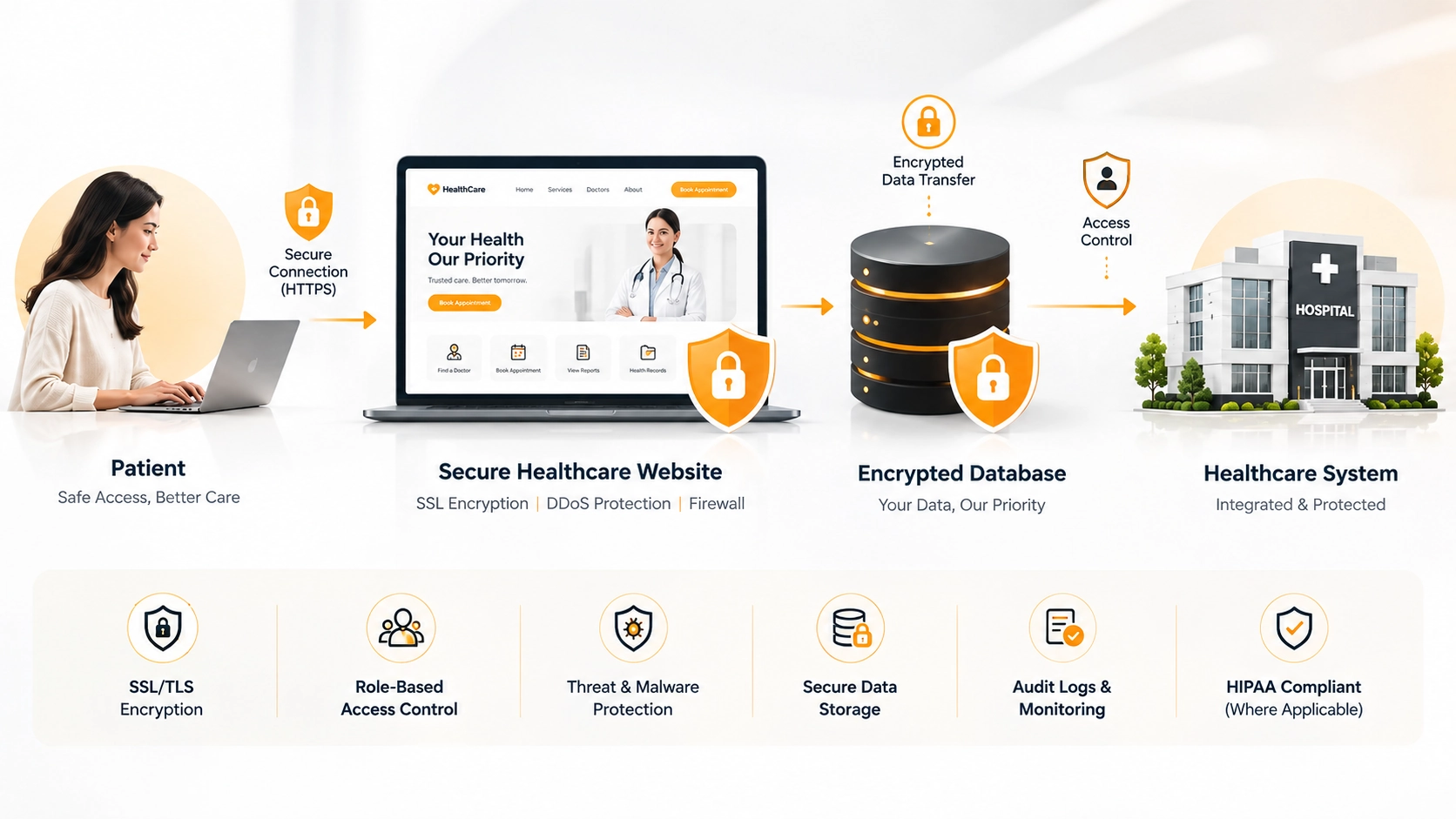
1. Protect Your Healthcare Website With HTTPS
HTTPS creates an encrypted connection between a visitor’s browser and the website. This is especially important when users submit information through healthcare forms or interact with protected areas of a website.
An SSL/TLS certificate is a basic security requirement for modern websites and helps protect information while it travels across a network.
However, HTTPS is only one layer of security.
Installing an SSL certificate does not automatically make a healthcare website HIPAA compliant. Other areas, including access controls, data storage, vendors, policies, monitoring, and risk management, may also need to be addressed.
2. Secure Healthcare Forms
Forms are common on healthcare websites, but not every form should be treated in the same way.
A basic enquiry form may collect only a name, email address, and phone number. Another form might ask a patient to describe a medical condition, provide insurance information, or submit other sensitive details.
Before collecting PHI through a website form, the organization should understand:
- What information is being collected
- Where that information goes
- How it is transmitted
- Where it is stored
- Who can access it
- Which third-party services process it
A useful rule is simple: only collect sensitive information through a system when you understand how that information is handled and have assessed whether the system is appropriate for the use case.
3. Secure Hosting and Infrastructure
Website security also depends on the infrastructure supporting the website.
For healthcare websites connected to sensitive systems, organizations may need to evaluate areas such as:
- Server security
- Encrypted connections
- Access controls
- Backup procedures
- Monitoring
- Logging and auditing
- Vulnerability management
- Disaster recovery
- Data retention
- Vendor agreements
This becomes particularly important when a website includes patient portals, databases, EHR connections, or other healthcare applications.
A visually secure website means little if the infrastructure behind it has not been properly considered.
4. Strong Authentication and Access Controls
Not every person working with a healthcare organization needs access to the same information.
A developer, marketing employee, receptionist, healthcare administrator, and clinical user may have completely different responsibilities. Access should reflect those responsibilities.
Depending on the system, appropriate controls may include:
- Strong password policies
- Multi-factor authentication
- Role-based access
- User account management
- Secure session handling
- Restricted administrator access
- Protected storage of credentials and secrets
The principle of least privilege is particularly useful here: users should receive the access they need to perform their responsibilities rather than broad access by default.
5. Secure Third-Party Integrations
Modern healthcare websites rarely operate completely on their own.
A website may connect to:
- Appointment scheduling systems
- Communication platforms
- Analytics tools
- CRM software
- Payment services
- Email platforms
- Chat applications
- Telehealth systems
- EHR platforms
Every integration introduces another system that may interact with website or patient information.
Before adding a third-party service, determine what information it receives, why it receives it, how that information is processed, and what security and contractual arrangements apply.
Where a vendor is acting as a business associate under HIPAA, the applicable Business Associate Agreement requirements should also be addressed.
A well-known or widely used platform is not automatically appropriate for handling PHI. Each integration should be evaluated according to the actual use case.
6. Data Encryption and Secure Storage
Sensitive information should be protected both while it is being transmitted and, where appropriate, while it is stored.
Encryption may need to be considered across different parts of the technology environment, including:
- Website connections
- Databases
- Backups
- APIs
- File storage
- Internal communications
- Connected healthcare systems
The exact implementation depends on the architecture and the type of information being handled.
Encryption should therefore be viewed as part of a broader security strategy rather than as a standalone compliance feature.
7. Security Monitoring, Updates, and Maintenance
Launching a secure website is not the end of the security process.
Websites depend on CMS software, plugins, libraries, hosting systems, APIs, integrations, and other technologies. These components can require updates and security patches over time.
Ongoing maintenance may include:
- Software and plugin updates
- Security patching
- Vulnerability scanning
- User access reviews
- Backup testing
- Security monitoring
- Third-party dependency reviews
- Log monitoring
- Incident response procedures
A website that was secure when launched can become vulnerable later if its software and connected systems are neglected.
For healthcare organizations, security maintenance should therefore be part of the long-term website plan.
HIPAA Compliance vs. Website Security: What's the Difference?
Website security and HIPAA compliance are closely connected, but they are not the same thing.
Website security focuses on protecting the website, applications, systems, and information from unauthorized access, misuse, disruption, or loss.
HIPAA compliance involves a wider set of administrative, physical, and technical safeguards, along with organizational processes related to protected health information.
For example, installing HTTPS helps protect information while it travels between a user’s browser and a website. It does not, by itself, address user permissions, employee procedures, vendor relationships, risk assessments, documentation, or incident response.
Similarly, choosing secure hosting does not automatically resolve every HIPAA-related responsibility.
Understanding this distinction helps healthcare organizations avoid treating HIPAA as simply an SSL certificate, hosting package, or website plugin.
Common HIPAA Compliance Mistakes Healthcare Websites Should Avoid
Asking Too Many Questions
Only request information that is necessary for the purpose of the form. Collecting additional sensitive information creates additional responsibility around how that data is handled.
Leaving Administrative Accounts Unsecured
Administrator accounts can provide extensive control over a website and its connected resources. Strong authentication, limited access, and regular account reviews are important safeguards.
Not Updating
CMS platforms, plugins, libraries, hosting environments, and integrations can receive important security updates. Delaying those updates can leave known vulnerabilities unaddressed.
Using Non-Standard Communication Channels
Third-party chat, scheduling, analytics, contact, and communication tools can collect or transmit information outside the organization’s primary website environment. Understand what each service collects before using it.
Not Using Backups
Technical failures, accidental changes, and security incidents can result in data loss. Backups should be created, tested, protected, and managed as part of the overall maintenance strategy.

How to Build a HIPAA-Compliant Healthcare Website
A secure healthcare website should be planned before development begins.
Step 1: Identify the data you need to handle
Start by documenting what the website collects, processes, stores, and sends to other systems.
Determine whether any of that information may fall under the definition of PHI and identify where it enters the system.
Step 2: Determine data flow
Map what happens after a visitor submits a form or performs another action.
For example:
Patient → Website → Form Provider → Database → Healthcare System
Understanding this flow makes it easier to identify which systems and vendors interact with sensitive information.
Step 3: Pick the right technologies
Choose the CMS, hosting provider, databases, form tools, APIs, integrations, and other technologies according to the actual requirements of the project.
A cheaper or more familiar solution is not automatically the appropriate solution for handling sensitive healthcare information.
Step 4: Review third parties
Create a list of external vendors that may access or process PHI on behalf of the organization.
Review how each vendor handles the information and address applicable contractual requirements, including BAAs where required.
Step 5: Set up necessary security measures
Implement appropriate security controls across the website and its infrastructure.
This may include:
- Secure permissions
- User roles
- Authentication
- Security headers
- Encryption
- Backups
- Monitoring
- Protected databases
Step 6: Test everything
Testing should cover more than visual design.
Review forms, authentication, permissions, integrations, security controls, accessibility, mobile responsiveness, performance, and important user journeys before launch.
Step 7: Set up maintenance procedures
Define how the website will be updated, monitored, backed up, reviewed, and maintained after launch.
Security should remain an ongoing process rather than a one-time development task.
HIPAA-Compliant Website Development for Clinics vs. Hospitals
The digital requirements of a small clinic and a large hospital network can be very different.
Clinics and Medical Practices
A smaller healthcare practice may need a relatively focused website with:
- Appointment booking
- Doctor profiles
- Service pages
- Contact forms
- Patient portal access where applicable
- Location information
- Insurance details
- Local SEO
Although the website may contain fewer pages and integrations, privacy and security still require careful planning.
Hospitals and Healthcare Networks
Hospital websites tend to have more complex digital ecosystems.
They may include:
- Multiple locations
- Large physician directories
- Advanced search
- Patient portals
- EHR integrations
- Appointment scheduling
- Multiple departments
- Careers
- Large content libraries
- Multilingual functionality
- Accessibility requirements
The larger the organization and technology environment, the more coordination may be required between clinical, administrative, IT, marketing, security, and other teams.
HIPAA, Accessibility, and SEO Should Work Together
Security is only one part of a successful healthcare website.
A strong healthcare website also needs to be accessible, easy to navigate, fast, and discoverable through search.
These areas support different parts of the patient experience:
- Security helps protect sensitive information.
- Accessibility makes digital information easier to use for people with different needs.
- SEO helps relevant healthcare information become easier to discover.
- UX design makes navigation and important actions clearer.
- Performance helps pages load efficiently across devices.
These elements should not be planned as completely separate projects. The best results usually come from considering them together during the website strategy, design, development, and maintenance stages.
For related guidance, healthcare organizations can also explore our article on 7 Must-Have Features Every Healthcare Website Needs in 2026, along with our Healthcare Website Design & Development Services.
HIPAA-Compliant Website Development Checklist
Before launching a healthcare website, review the following:
- HTTPS is properly configured.
- Sensitive information is handled through appropriate systems.
- Website forms have been reviewed for privacy and security.
- Third-party services have been evaluated.
- Applicable BAAs are in place where required.
- User permissions are appropriately configured.
- Strong authentication is implemented where appropriate.
- Sensitive information is adequately protected.
- Backups are configured and protected.
- Software and dependencies are maintained.
- Security monitoring has been considered.
- Accessibility has been addressed.
- Mobile responsiveness has been tested.
- Website performance has been optimized.
- Privacy and security documentation has been reviewed.
- An ongoing maintenance process is established.
This checklist is a practical starting point, not a substitute for a formal HIPAA compliance assessment. The source material also makes this distinction.
Why Work With a Healthcare Website Development Specialist?
Healthcare website development involves much more than creating an attractive interface.
Depending on the project, the website may need to balance:
- Patient experience
- Privacy
- Security
- Accessibility
- SEO
- Performance
- Integrations
- Compliance considerations
- Business objectives
Working with a team that understands these different requirements can help identify technical and usability concerns earlier in the project.
A healthcare website development specialist should be able to think beyond visual design and consider how the website will be used, what information it handles, which systems it connects to, how it performs, and how it will be maintained.
For healthcare organizations, this broader approach can create a website that is not only professional but also practical, secure, accessible, and easier for patients to use.
Build a Better Digital Experience for Your Healthcare Organization
A healthcare website often becomes the first digital interaction between a patient and an organization.
Whether you are launching a new clinic website, redesigning a hospital website, adding appointment functionality, or connecting digital healthcare services, privacy and security should be considered from the beginning.
HIPAA-focused website development involves technology, data flows, security controls, vendors, processes, and ongoing maintenance. It is a broader responsibility than simply installing a security certificate.
With the right approach, healthcare organizations can create a digital experience that makes information easier to access while giving appropriate attention to privacy, security, usability, and performance.
FAQs
A website is not made compliant by one factor. It is determined by the activities of the organization. How protected health information is collected, transmitted, stored, accessed, and managed plays a role, as well as technical, policies and procedures, vendor relationships, and other requirements.
No. HTTPS protects information during transmission, but HIPAA considerations can also involve access controls, data storage, vendors, policies, risk management, and other safeguards.
Yes, but the organization should first evaluate what information the form collects, where it goes, how it is stored, and whether the form technology and vendor are appropriate for that information.
Not necessarily. A patient portal can be useful when an organization wants to provide secure digital access to appointments, records, messages, documents, or other healthcare services.
They can be appropriate when properly evaluated, but every vendor should be reviewed based on the information it handles and how it processes that information. Applicable HIPAA business associate requirements should also be considered.
The CMS alone does not determine compliance. A healthcare organization needs appropriate security practices, hosting, access controls, integrations, maintenance, monitoring, and processes for its specific environment.
There is no single review interval that fits every organization. Ongoing maintenance, security monitoring, access reviews, vulnerability checks, updates, and backup testing should be part of the website’s continuing security process.
The cost depends on factors such as website size, functionality, integrations, security requirements, patient portals, content, design, hosting, and ongoing maintenance. A small clinic website can have very different requirements from a hospital network.
A development agency can implement security-conscious technical practices, but HIPAA compliance extends beyond website development. Healthcare organizations should involve appropriate compliance, legal, security, and IT professionals when assessing their complete environment.
Look for experience with healthcare websites, security-conscious development, accessibility, SEO, performance, responsive design, integrations, and ongoing maintenance. The team should understand that HIPAA involves more than an SSL certificate.

