
Contents
- 1. At a Glance
- 2. Introduction
- 3. How Much Does a Healthcare Website Cost?
- 4. Healthcare Website Cost by Project Scope
- 5. What Factors Affect Healthcare Website Cost?
- 6. Healthcare Website Cost by Organization Type
- 7. One-Time and Ongoing Healthcare Website Costs
- 8. The Deceptively Simple Ways to ReduceHealthcare Website Expenses
- 9. Choosing the Right Healthcare Web Development Partner
- 10. Build a Healthcare Website That Delivers Long-Term Value
- 11. Final Thoughts
- 12. FAQs
At a Glance
It is a common question when looking for an agency that provides healthcare website development services – how much does it cost to build a website? The answer depends on several factors: the size and complexity of the website, its design and functionality, third-party integrations, security, SEO, and other elements. Generally, the more advanced and high-end the solution for your clinic or hospital website development needs is, the higher the cost will be. It also has to be said that there are several additional expenses that may arise during the development process. Thus, it is advisable to decide on the website’s key pages, functionality, and content, as well as identify the expected integrations and outline the website’s purpose and future-proofing expectations before getting quotes from potential developers.
Introduction
The cost of building a healthcare website can vary significantly depending on its size, design, features, and technical requirements. A small medical practice may only need a few informative pages and an appointment form, while a hospital may require advanced systems such as provider directories, patient portals, and third-party integrations.
Instead of focusing on a fixed price, healthcare organizations should consider which features are genuinely necessary for their patients and staff. Factors such as website complexity, number of pages, custom design, security requirements, booking functionality, integrations, and ongoing maintenance can all affect the final investment.
Planning these requirements in advance makes it easier to set a realistic budget and choose solutions that provide value without paying for unnecessary functionality.
How Much Does a Healthcare Website Cost?
Website cost and development time are dictated by the scope of the project. The complexity of a healthcare website is defined by its size, design, functionality, integrations, content, SEO, security, and subsequent maintenance.
A single page website for a small independent clinic will not require the same amount of development as a multi-facility hospital corporate website with advanced functionality.
Instead of comparing the quantity of pages, analyze the objectives of the website. For instance:
- A small independent clinic – a minimalistic website design that focuses on generating leads and setting up consultations
- A medical practice – a more complex website with extended information about the doctors and procedures
- A multi-specialty clinic – an advanced navigation system, additional location options, and online booking functionality
- A hospital – a sophisticated portal with patient login, directories, third-party applications, and a vast amount of content
The more complex the design and functionality of the website, the higher the development cost and the longer the time required to set up the site.
Healthcare Website Cost by Project Scope
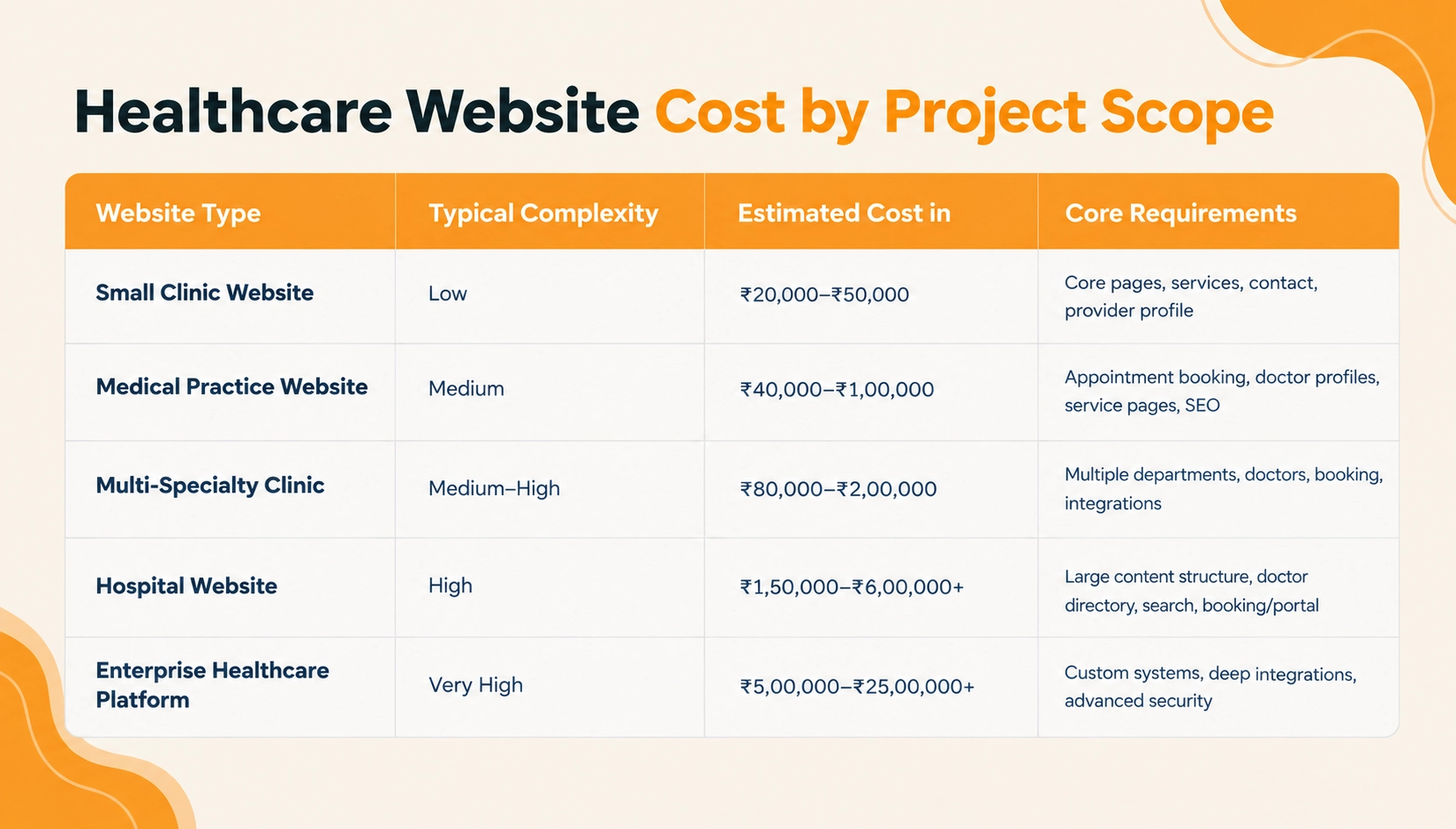
These categories are a starting point for thinking about scope — the real cost still depends on your specific requirements, functionality, integrations, content, security, and long-term support needs.
What Factors Affect Healthcare Website Cost?
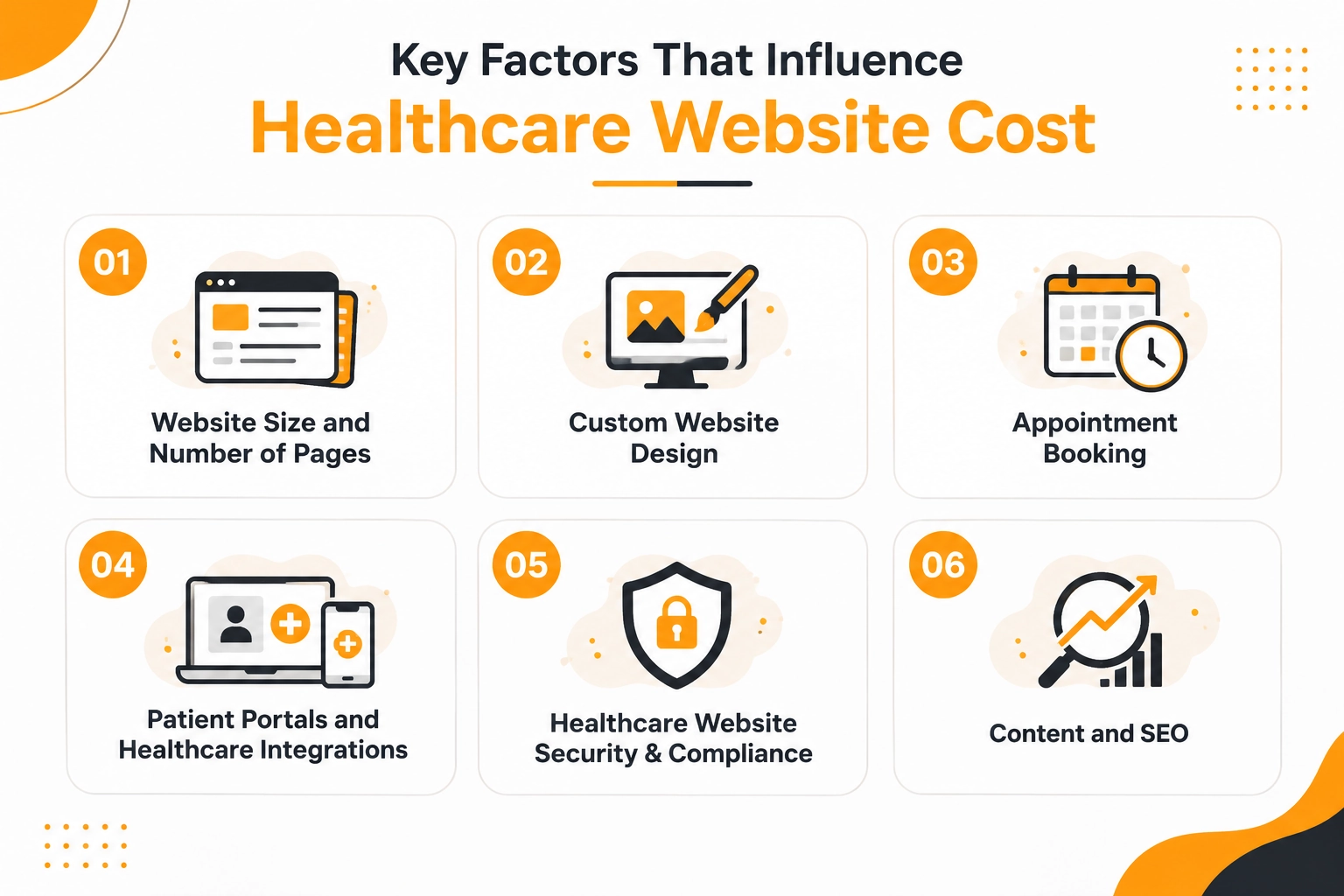
1. Size of Website / Number of Pages
The more pages your healthcare website requires, the more the website development will likely cost.
A small healthcare website may have pages like Home, About, Services, Doctors, Contact, Locations, and Appointment.
A hospital may have additional pages for departments, doctors, treatments, conditions, locations, patient resources, careers, and health information.
Additional content and pages lengthen the timeline for planning, designing, and developing your website. The more complex your healthcare website is, the more it may cost to develop.
2. Custom Web Design
A healthcare website built using a template could be vastly different from a custom healthcare website.
Custom web design can mean many different things. It can mean custom page layouts and branded page elements.
It can also mean designing a website that puts the patient first and makes it easy for them to find the information they are looking for. A custom healthcare website could allow you to build custom pages for your services and doctors. You may also want a mobile responsive design that adapts to different devices and screen sizes.
3. Appointment Booking
Appointment booking is a critical feature for many healthcare websites.
A basic healthcare website might have a link to an external booking tool, while a more complex booking tool might require an entirely custom booking system.
Appointment booking can include features like: finding the right doctor, types of appointments, availability, confirming appointments, and third party booking tools. The more features you want, the more it may affect the cost of your healthcare website development.
4. Patient Portals & Healthcare System Integrations
For some healthcare organizations, having a portal on their website is important. Connecting your website to external healthcare systems may be necessary for some organizations.
Systems you may want to integrate with your healthcare website include: patient portals, EHR / EMR, scheduling, CRM, billing, and telehealth.
The complexity of the integration will vary depending on what you want your website to do. Before finalizing your plan for the healthcare website, make a list of external systems that you want to connect to. This will help your development team give you a more accurate estimate.
5. Healthcare Website Security & Compliance
Depending on what information you collect from patients, the security and compliance features for your healthcare website can vary.
You may need to budget for items like encrypted data transfer and storage, user authentication, user permissions, regular backups, and security audits. The healthcare IT systems you use (hosting, CMS, etc.) will need to meet certain standards.
If your healthcare organization has any HIPAA requirements, make sure that you consult with the right experts to ensure that you cover all of your legal and security needs.
Having a secure healthcare website not only protects your practice, but it also builds patient trust.
6. Content & SEO
Content is one of the most important aspects of a healthcare website. It is important to have content that your patients will want to read. It’s also important to make sure that your content is crawlable by search engines. Some content you may want to have on your healthcare website includes:
- Services
- Doctors & Specialists
- Treatments
- Locations
- FAQs
- Patient Resources
SEO can include elements like keyword research and optimization, on-page SEO, technical SEO, content strategy, internal linking, and local SEO. It’s important to plan for SEO before developing your website, because adding SEO features after launch can be more expensive.
Planning SEO during development can prevent costly restructuring later.
Healthcare Website Cost by Organization Type
The types of healthcare organizations vary, which is why their website needs to be built differently. Website Requirements depend on what type of Healthcare Facility it is.
Clinic Website
A small-scale clinic website would consist of basic core pages, informative and attractive design, necessary information about services, doctors, locations, and contacts, appointment setting.
Medical Practice Website
A private medical practice requires having more information pages and having a website optimized for local search, blog for the patients, and online appointment setting.
Multi-Specialty Clinic
A multispecialty clinic would have more departments, doctors, locations, services, and required information for each of them, more complex navigation, and online booking.
Hospital Website
A hospital website would be more data-intensive as it is a larger institution. It would have more information about the organization, its departments, locations, and services, pages for doctors and patients, online booking, and healthcare-related content.
This is why Healthcare Website Cost depends on the scale and complexity of the project.
One-Time and Ongoing Healthcare Website Costs
When budgeting for your project, make sure to separate one-time and ongoing costs. One-time costs include designing and developing the website. They can consist of the following:
One-Time Costs
- Website strategy
- UX/UI design
- Development
- Content migration
- Integrations
- Initial SEO
- Testing
- Website launch
Ongoing costs are the ones that will occur after the initial launch of the website. These can include:
- Hosting
- Website maintenance
- Security
- Software licenses
- SEO
- Technical support
- Content updates
Your professional healthcare website needs to be consistently maintained and updated.
Hidden Costs to be Aware of
There are often expenses beyond the initial estimate for developing a healthcare website.
Based on the project’s scope, you may encounter charges for website hosting, advanced software, booking systems, external API integration, professional photography, content development, search engine optimization, website accessibility evaluation, and continued maintenance.
When reviewing proposals from web development firms, request a detailed breakdown of inclusions and separate expenses.
The Deceptively Simple Ways to ReduceHealthcare Website Expenses
One of the simplest ways to lower costs while developing a website is not to choose the cheapest provider for your website development.
Instead, you should ask yourself about the key features that your patients will be looking for and what the staff should be managing. In turn, avoid opting for the bells and whistles that the providers tend to suggest.
Another way is to make sure that you have time to prepare the content of the website, the details about the providers, the images, and the brand assets.
Finally, you may want to consider the long-term costs of supporting and expanding the website. The structure and architecture of the website will define how much money you will spend on SEO, website maintenance, new features, and functions.
Choosing the Right Healthcare Web Development Partner
The right development partner can have a major impact on your website’s quality and long-term performance.
Look for a company with experience in:
- Healthcare website design
- Responsive development
- SEO
- Accessibility
- Security-conscious development
- Healthcare integrations
- Website maintenance
Before choosing a provider, ask for relevant examples, a clear project scope, development timeline, pricing details, and information about post-launch support.
Don’t compare agencies based only on the lowest quote. Consider the overall value, expertise, functionality, and long-term support included in the project.
Build a Healthcare Website That Delivers Long-Term Value
Choosing an experienced offshore outsourcing company can make all the difference for your website!
When looking for the right firm, be sure to ask for:
- Healthcare website design experience
- Responsive development
- SEO Expertise
- Accessibility
- Development in security-focused
- Healthcare integration
- Website maintenance
Don’t forget to ask for previous work examples, general project scope, timeline, cost, and what the company will do for ongoing support after website launch.
While price is always an important factor, make sure to prioritize quality, value, functionality, and support when selecting the best healthcare website development partner.
Final Thoughts
Choosing the right Divi Theme WordPress developer is about more than finding someone who can build pages with Divi.
You need someone who understands your business objectives, user experience, WordPress development, responsive design, performance, SEO, integrations, and long-term website maintenance.
For straightforward projects, template customization may be sufficient. For more complex requirements, custom Divi development can provide significantly greater flexibility.
Likewise, a freelancer may be ideal for a small project, while an agency can make more sense when you need a broader range of services and ongoing support.
Ultimately, the best developer is not necessarily the cheapest or the one with the longest list of services.
Choose the developer who best understands what your website needs to achieve.
If you are planning a new Divi website, redesign, customization, migration, or WooCommerce project, working with an experienced Divi WordPress developer can help you turn your requirements into a professional, scalable website.
FAQs
A healthcare website cost varies depending upon the size, design, features, integrations, content, security, SEO, and long-term maintenance and support.
Depending on a project, website development can include strategy, design, responsive development, CMS, content migration, integration, SEO, launch and ongoing support.
Clinic website cost depends on the number of pages and features. Clinic websites typically have fewer requirements than multi-specialty or hospital websites.
Hospital websites can be more complex and require more development due to the size, departments, locations, providers, resources, integrations, and more.
It can. Websites that deal with protected health information may require additional security, technology, vendors, and more.
It should be. SEO should be designed into the website foundation and architecture to simplify the process of publishing service, location, and provider pages.
They often are. Maintenance, hosting, security, technical support, SEO, and content updates can be handled as separate budget items.
Create a list of the pages you need, features, integrations, content, and goals for the project for a healthcare website development company to receive a detailed quote.

