
Contents
- 1. Introduction
- 2. What Is Native Mobile App Development?
- 3. What Is Cross-Platform Mobile App Development?
- 4. Native vs Cross Platform: Key Differences
- 5. Native vs Cross Platform Mobile App Development: Performance
- 6. Native vs Cross Platform: Development Cost and Time
- 7. When Should You Choose Native App Development?
- 8. When Should You Choose Cross Platform App Development?
- 9. Native Android App vs Cross Platform Application
- 10. What About Maintenance and Scalability?
- 11. Native vs Cross Platform Mobile App Development: Which One Should You Choose?
- 12. Native vs Cross Platform: Quick Decision Guide
- 13. Conclusion
- 14. FAQs
Introduction
Choosing the right technology for your mobile app can directly impact its performance, development cost, user experience, scalability, and time to market. The two most common approaches are native mobile app development and cross platform mobile app development.
But which one should you choose?
If you are planning to build an app for Android and iOS, understanding the difference between native vs cross platform mobile app development is essential. Native development offers platform-specific performance and capabilities, while cross-platform development allows businesses to build applications for multiple platforms using a shared codebase.
This guide compares both approaches to help you decide which option fits your business, budget, technical requirements, and long-term goals.
What Is Native Mobile App Development?
Native mobile app development means creating an application specifically for a particular operating system.
For example:
- Android apps are commonly developed using Kotlin or Java.
- iOS apps are commonly developed using Swift or Objective-C.
Because native applications are built specifically for their target platform, developers can directly use the operating system’s APIs, hardware capabilities, and native UI components.
Key benefits of native mobile app development
- Excellent performance
- Smooth and responsive user experience
- Full access to device features
- Strong platform-specific security capabilities
- Better support for complex animations and graphics
- Easier integration with advanced hardware features
However, if you want separate Android and iOS applications, you generally need separate development efforts. This can increase both development time and cost.
What Is Cross-Platform Mobile App Development?
Cross platform mobile app development allows developers to build applications for multiple operating systems using a shared codebase.
Popular technologies include:
- Flutter
- React Native
- .NET MAUI
Instead of creating completely separate applications for Android and iOS, developers can reuse a significant portion of the code across platforms.
This makes cross platform development attractive for businesses that want to launch their application faster while controlling development costs.
Key benefits of cross-platform development
- Shared codebase
- Faster development
- Lower development costs
- Easier maintenance
- Faster deployment across Android and iOS
- Suitable for MVPs and startups
The trade-off is that some highly specialized features or platform-specific requirements may still require native code.
Native vs Cross Platform: Key Differences
The biggest difference between native vs cross platform mobile development is how the application is built and maintained.
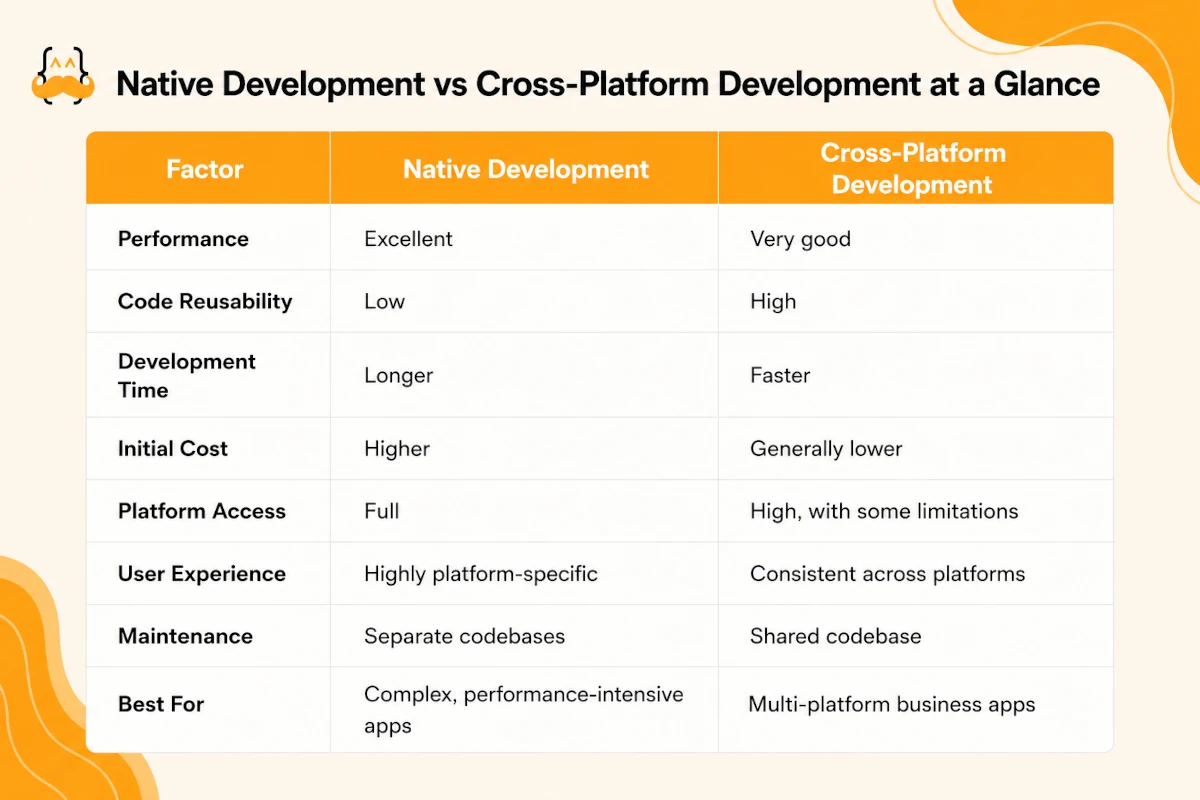
Neither approach is universally better. The right choice depends on what your application needs to accomplish.
Native vs Cross Platform Mobile App Development: Performance
Performance is one of the most important considerations when comparing native vs cross platform mobile app development.
Native apps communicate directly with the operating system and can take full advantage of platform-specific capabilities. This makes native development particularly suitable for applications requiring intensive processing, advanced animations, real-time operations, or complex hardware integration.
Modern cross-platform frameworks have also improved significantly. For many business applications, e-commerce apps, content platforms, and productivity tools, the performance difference may not be significant enough to justify maintaining separate native codebases.
In simple terms: If maximum platform-specific performance is your priority, native development has an advantage. If you need strong performance combined with faster multi-platform development, cross-platform can be an excellent option.
Native vs Cross Platform: Development Cost and Time
One of the biggest reasons businesses consider cross platform mobile application development is cost.
With native development, building for both Android and iOS typically requires separate development work. This can mean additional developers, testing, maintenance, and updates.
With cross-platform development, developers can reuse much of the same code for both platforms.
For example, a business launching an e-commerce application may need:
- Product catalog
- User accounts
- Search
- Shopping cart
- Payment integration
- Push notifications
- Order tracking
A cross-platform approach can allow much of this functionality to be developed from a shared codebase.
This can reduce development time and help businesses launch their product faster.
However, the actual cost depends on the application’s complexity, integrations, design requirements, developer expertise, and maintenance needs.
When Should You Choose Native App Development?
Native development can be the better choice when your application requires maximum performance or deep integration with a specific operating system.
Consider native development if you are building:
- High-performance gaming applications
- Advanced financial or banking applications
- Applications with complex animations
- AR/VR applications
- Apps requiring extensive hardware integration
- Highly platform-specific experiences
- Applications with demanding real-time processing requirements
For example, an application that relies heavily on advanced camera functionality, Bluetooth communication, GPS processing, or graphics-intensive operations may benefit from native development.
When Should You Choose Cross Platform App Development?
Cross platform app development is often a strong choice when you want to reach both Android and iOS users while keeping development efficient.
It can be particularly suitable for:
- Startups
- MVP development
- E-commerce applications
- Business applications
- Social platforms
- Content applications
- Internal enterprise applications
- Apps with standard device functionality
If your primary goal is to validate an idea quickly and launch on multiple platforms, cross-platform development can provide an efficient path to market.
Native Android App vs Cross Platform Application
Businesses targeting Android users may also wonder whether they should build a native Android app or choose a cross-platform solution.
A native Android app can provide excellent integration with the Android ecosystem and allow developers to use Android-specific APIs and capabilities directly.
On the other hand, if your business plans to launch on both Android and iOS, a cross-platform application can reduce duplicated development work.
The decision should therefore be based on your target audience and technical requirements rather than simply choosing the technology that is currently most popular.
What About Maintenance and Scalability?
Development is only one part of building a mobile application. Your app will need regular updates, security improvements, bug fixes, operating system compatibility updates, and new features.
With native development, Android and iOS applications generally require separate maintenance.
With cross-platform development, a shared codebase can simplify many updates and feature improvements.
However, cross-platform does not mean “write once and never maintain.” Developers may still need platform-specific adjustments when operating systems, APIs, or third-party integrations change.
For long-term scalability, businesses should evaluate:
- Expected number of users
- Future features
- Third-party integrations
- Platform requirements
- Maintenance resources
- Security requirements
- Development team expertise
Native vs Cross Platform Mobile App Development: Which One Should You Choose?
There is no single answer to native vs cross platform mobile app development.
Choose native development when:
Performance, platform-specific functionality, advanced hardware integration, and a highly customized user experience are your top priorities.
Choose cross-platform development when:
Faster development, lower initial costs, code reusability, and launching on multiple platforms are your main priorities.
For many startups and businesses, cross-platform development provides an excellent balance between cost, speed, performance, and platform reach. For technically demanding applications, native development may provide the additional control and performance required.
Native vs Cross Platform: Quick Decision Guide
Use this simple framework:
Choose Native if you need:
- Maximum performance
- Complex device integration
- Advanced graphics
- Platform-specific features
- Highly customized platform experiences
Choose Cross-Platform if you need:
- Faster development
- Android + iOS from one codebase
- Lower development overhead
- Faster time to market
- Easier shared maintenance
Ultimately, the best mobile development approach should be selected according to your business objectives, application complexity, target users, budget, and future roadmap.
Conclusion
The debate around native vs cross platform should not focus on which technology is universally superior. Instead, focus on what your application actually needs.
Native mobile app development provides maximum platform-specific control and performance. Cross platform mobile app development provides code reusability, faster development, and an efficient way to target multiple platforms.
The right decision is the one that aligns your technology choice with your business goals, users, budget, performance requirements, and long-term growth.
FAQs
Not necessarily. Native development is better for applications requiring maximum performance and deep platform integration, while cross-platform development is often better for businesses prioritizing speed, cost efficiency, and multi-platform deployment.
Native development creates applications specifically for one operating system, while cross-platform development uses a shared codebase to build applications for multiple operating systems.
It can be. Because developers can reuse much of the code across Android and iOS, cross-platform development can reduce duplicated development effort. The final cost still depends on the application’s complexity and requirements.
Cross-platform development is often a practical choice for startups that want to launch an MVP quickly and reach both Android and iOS users. Native development may be preferable when the product requires highly specialized functionality.
Yes. Modern cross-platform frameworks can deliver strong performance for many types of applications. However, applications requiring highly specialized or intensive platform-specific functionality may still benefit from native development.
Both approaches can support long-term applications. The right choice depends on the product roadmap, technical requirements, development team, maintenance strategy, and platform-specific needs.

