
Contents
- 1. TL;DR
- 2. Introduction
- 3. Why SEO and Web Development Can't Be Separated for Healthcare Sites
- 4. Local SEO: The Foundation Most Clinics Get Wrong
- 5. Site Architecture: Building a Clinic Website Google Can Actually Understand
- 6. Content Strategy That Matches Real Patient Search Behavior
- 7. Site Speed and Technical Health as an SEO Multiplier
- 8. Trust Signals That Support Both Rankings and Patient Decisions
- 9. What a Coordinated Strategy Actually Looks Like in Practice
- 10. Conclusion
- 11. FAQs
TL;DR
- SEO and website development should not be treated as two unrelated services. For a healthcare website, both need to work together from the beginning.
- Many clinics struggle to appear on the first page of Google because their website and SEO strategy were developed separately.
- Effective healthcare SEO starts while the website is being planned and built, rather than after the website has already gone live.
- A website needs clean, well-organized code that search engines can crawl and understand.
- The website structure should reflect the services, treatments, conditions, and locations that potential patients are actually searching for.
- Fast loading times matter because patients are unlikely to wait around for a slow clinic website when other options are available.
- SEO involves much more than adding keywords to blog posts. It also covers site architecture, useful content, technical performance, user experience, and local search visibility.
- Clinics can benefit from working with a web development and SEO team that understands both the technical side of a website and the way patients search online.
- The ultimate objective is to make the clinic easier to discover when people in its service area search Google for relevant medical services.
Introduction
A clinic owner may hire an SEO company, receive a keyword list, approve a content calendar, and publish several blog articles. At the same time, a web developer may create a modern-looking website with attractive images, information about the clinic, and a contact form. Months later, the clinic may still struggle to appear for searches such as “pediatrician near me” or “dermatologist in [city].“
So what went wrong?
One of the biggest problems is treating SEO and website development as completely separate projects. A website is not simply a design that gets SEO added to it later. The way its pages are organized, coded, linked, written, and delivered to users can all affect how easily search engines understand and index it.
For healthcare businesses, this connection is particularly important. Patients often search for specific treatments, symptoms, specialists, doctors, and nearby clinics before deciding where to book an appointment. A website therefore needs to serve two audiences at the same time: the person looking for healthcare information and the search engine trying to understand what each page offers.
This article explains how healthcare SEO and web development can be planned together, why that matters for local visibility, and what clinic owners should look for when evaluating their current website or planning a new one.
Why SEO and Web Development Can't Be Separated for Healthcare Sites
SEO is often reduced to a simple formula: find keywords, publish content, and build backlinks. Those activities can be important, but they are only part of the picture. Many SEO decisions are connected to the way the website itself is designed and developed.
Consider a few practical examples for a clinic website:
- You may have a detailed page about pediatric dentistry, but if the page is difficult for search engines to crawl, loads poorly, or has technical problems, the content may not achieve the visibility you expect.
- A visually impressive homepage can still create problems if it relies on huge images and takes several seconds to become usable, particularly for patients browsing on mobile devices.
- If a clinic offers ten different services but places every service on one overloaded page, it becomes harder to create a focused page that clearly addresses each individual search intent.
This is why SEO should be considered during website planning rather than treated as a post-launch task. URL structures, navigation, page templates, headings, image handling, internal links, mobile performance, and technical implementation all influence how effectively a healthcare website can be discovered.
The goal is not to make the developer responsible for every part of SEO or the SEO specialist responsible for development. Instead, both sides should work from the same strategy so that technical decisions support the search strategy and the content strategy fits the website’s structure.
Local SEO: The Foundation Most Clinics Get Wrong
For most clinics, the primary search audience is not people across an entire country. It is usually patients who live in the same city, neighborhood, or surrounding area and are looking for healthcare services they can actually visit.
That makes local SEO a major part of healthcare visibility. It also means the website’s content and technical setup need to reinforce the clinic’s local relevance.
Here are several local SEO fundamentals where development and SEO overlap:
- Google Business Profile alignment. The clinic’s name, address, and phone number should be consistent between its website and Google Business Profile. Even small inconsistencies in business information can create confusion about which location or organization a listing represents.
- Location-specific landing pages. Clinics serving several neighborhoods, suburbs, or nearby towns can create useful location pages where there is a genuine reason to serve those areas. Each page should provide useful local information rather than simply repeating the same content with a different city name.
- Schema markup for medical organizations. Structured data can help search engines understand important details about a healthcare organization, such as its business type, address, opening hours, services, and other relevant information. This is implemented within the website’s technical layer but supports search visibility.
- Consistent, crawlable navigation. A navigation system may look excellent visually but still create problems if important pages are hidden behind complicated interactions or inaccessible links. Service and location pages should be easy for both visitors and search engines to discover.
Notice that several of these improvements do not require publishing another blog post.
They require the website to be built and maintained with search visibility in mind. That is why clinics benefit from having an SEO-aware developer, or a development team and SEO specialist who work closely from the same roadmap.
Site Architecture: Building a Clinic Website Google Can Actually Understand
Search engines have an easier time understanding a website when its structure reflects the services and information the business actually provides.
For a multi-specialty clinic or a practice that offers several treatments, a useful structure can look something like this:
- Homepage — Introduces the clinic, establishes trust, explains its main services, and directs visitors toward important sections of the website.
- Service category pages — For example, a dedicated “Dermatology” page can sit separately from “Dentistry” or “Physiotherapy,” with each section focused on its own audience and search intent.
- Individual condition or treatment pages — A dermatology section might include dedicated pages for acne treatment, skin allergy consultations, cosmetic procedures, or other relevant treatments. Each page can answer the questions patients commonly have about that specific topic.
- Provider/physician pages — Individual doctor pages allow patients to learn about qualifications, specialties, experience, and areas of practice while also giving search engines more specific information to understand.
- Location pages — These can be particularly useful for clinics with multiple branches or practices that genuinely serve several nearby areas.
A structure like this benefits both sides.
Patients can reach the information they need without digging through one enormous page, while search engines can understand that the website contains separate, focused resources for different services, treatments, doctors, and locations.
The technical side matters here too. URL patterns, internal linking, breadcrumbs, page templates, navigation, and hierarchy should be considered before development is completed—not patched together after the website is already live.
Content Strategy That Matches Real Patient Search Behavior
A technically strong website cannot perform well if its content does not answer the questions people actually type or speak into search engines.
Healthcare content should reflect patient search intent rather than relying entirely on medical terminology used inside the profession.
A few search patterns are especially useful to understand:
- Symptom-based searches often happen before specialist searches. Someone experiencing knee pain might first search “why does my knee hurt when climbing stairs” rather than immediately searching for an orthopedic specialist. Helpful content that addresses the initial question can introduce the clinic to that person earlier in their search journey.
- “Near me” and location-based searches are important for healthcare. Location relevance should appear naturally throughout the website where appropriate, including service pages and contact information. Repeating a city name unnaturally throughout every paragraph is not a substitute for useful local content.
- Comparison and trust-related searches influence healthcare decisions. People may search for reviews, treatment options, provider credentials, expected results, risks, or questions such as “is this treatment safe?” Well-organized FAQs, clear treatment explanations, and transparent provider information can address these concerns.
- Conversational searches are increasingly relevant. Patients often phrase searches as complete questions, particularly when using voice search or mobile devices. Content that directly answers specific questions can make it easier for search engines and readers to identify the relevant information.
This is where SEO strategy becomes particularly important.
A developer can create a technically sound website, but technical structure alone cannot compensate for content that ignores patient intent. The information placed inside that structure needs to answer real questions and match the stage of the patient’s search journey.
Site Speed and Technical Health as an SEO Multiplier
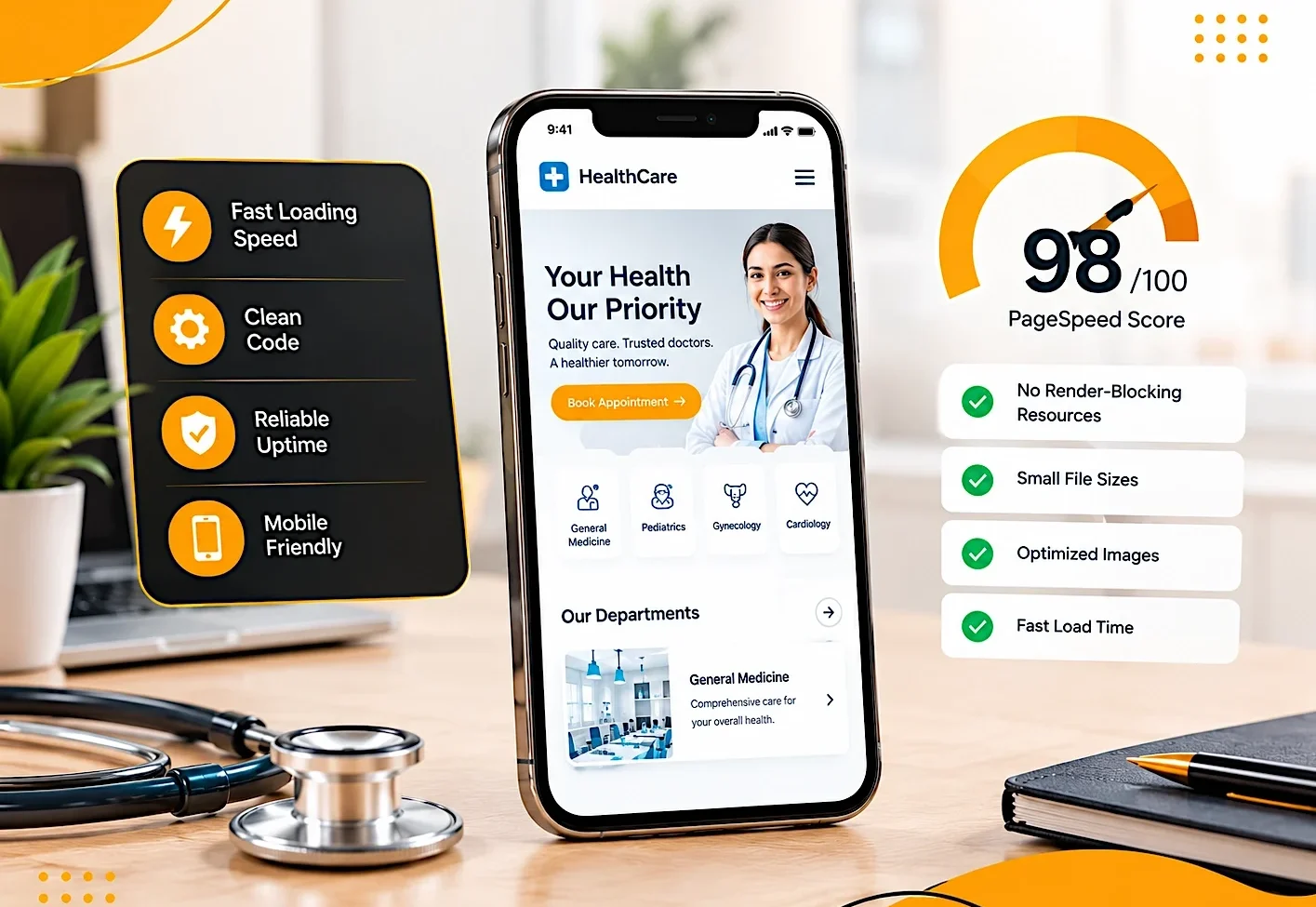
A clinic may have excellent content and a carefully planned website structure, yet still provide a poor experience if its website is slow, unstable, or difficult to use on a phone.
Website performance matters for both search visibility and patient experience. A person searching for a clinic is unlikely to remain on a page that takes too long to load when another healthcare provider is only one search result away.
Some common technical problems include:
- Large, uncompressed images of the clinic, doctors, staff, or medical equipment that increase page weight unnecessarily.
- Hosting environments that are poorly configured or unable to handle the website’s traffic efficiently.
- Too many third-party scripts, such as chat tools, appointment systems, analytics scripts, tracking pixels, and marketing integrations running at the same time.
- Mobile layouts that look fine in a desktop design preview but become difficult to navigate or interact with on actual smartphones.
- Poorly configured caching, scripts, fonts, or other website resources that increase loading time.
These problems cannot be solved simply by publishing another article or adding more keywords.
They belong to the technical side of the website and should therefore be included in any serious healthcare SEO audit. A complete strategy should look at both what the website says and how efficiently the website delivers that information.
Trust Signals That Support Both Rankings and Patient Decisions
The elements that help a healthcare website appear trustworthy to visitors often overlap with the information people expect to see before contacting a clinic.
Patients want confidence that they are dealing with a legitimate provider, while search engines also need clear information that helps them understand the organization and its services.
Important elements to consider include:
- Genuine patient reviews, presented clearly and prominently rather than making visitors search for them.
- Clear and verifiable provider credentials, including education, specialties, professional experience, and relevant qualifications.
- Useful information about services and appointments, including pricing information where appropriate and details about what a patient can expect during a visit.
- Easy-to-find contact and booking options, so visitors can take the next step without having to search through several pages.
- Secure and properly maintained website infrastructure, including HTTPS, updated software and plugins, working forms, and a reliable technical setup.
These elements do not belong exclusively to either SEO or web development.
They sit between the two. A website that communicates expertise clearly, works reliably, answers patient questions, and makes contacting the clinic straightforward can support both organic visibility and the user’s decision-making process.
What a Coordinated Strategy Actually Looks Like in Practice
For a clinic reviewing an existing website or preparing to build a new one, an integrated healthcare SEO and development process can follow a sequence such as this:
- Start with keyword and competitor research, identifying what people in the target area search for and how competing healthcare websites currently address those searches.
- Create the site architecture from that research, deciding which service, treatment, doctor, location, and supporting content pages are needed before the visual design is finalized.
- Build the website with SEO fundamentals included from the beginning — clean code, logical heading structures, appropriate structured data, optimized assets, strong internal linking, and a mobile-friendly experience.
- Create content around genuine patient search intent, answering the questions and concerns people have rather than producing articles simply to fill a content calendar.
- Monitor technical performance and content regularly, including Core Web Vitals, crawlability, broken links, indexing issues, outdated information, and changes in the way patients search.
Following this type of process can reduce the need for repeated website rebuilds caused by SEO problems that were discovered only after launch.
Instead, the website can be developed as a long-term search asset, with improvements made over time as the clinic grows and patient search behavior changes.
Conclusion
Getting a clinic to appear in Google search results is not simply a choice between SEO and web development. The two disciplines work best when they are planned together.
A polished website without a search strategy may struggle to attract organic visitors. On the other hand, a website filled with keywords and articles can still perform poorly if its structure, technical performance, navigation, or mobile experience is weak.
For healthcare businesses, the strongest foundation comes from bringing these areas together: clear site architecture, technically sound development, useful patient-focused content, local search optimization, strong trust signals, and ongoing maintenance.
If you are evaluating a website development or SEO partner for your clinic, don’t only ask, “Do you provide SEO?” or “Can you build a website?“
A more useful question is whether the team understands how the two disciplines work together—and whether they can demonstrate that the websites they build are structured with search visibility, patient experience, and long-term growth in mind from the very beginning.
FAQs
Either can work, but the two must communicate and plan together closely. The bigger risk isn’t having separate providers — it’s having them work in isolation without coordinating on site structure, keyword targeting, and technical performance.
Meaningful local SEO improvement often takes a few months, since it depends on consistent technical health, accurate business listings, and content that matches patient search behavior. Sudden, overnight ranking jumps are uncommon and can sometimes indicate risky tactics rather than sustainable results.
Not strictly, but well-written, patient-focused content — whether structured as blog posts or as detailed service and condition pages — significantly expands the number of relevant search terms a clinic can realistically rank for.
Schema markup is structured code added to a website that explicitly describes information like business type, hours, and services to search engines. For local healthcare providers, it makes a meaningful difference in how confidently Google can display accurate information in search results and map listings.
No. Site speed and structure are necessary foundations, but content still needs to reflect real patient search intent. Strong technical performance without relevant content is like a fast, empty highway — the infrastructure works, but there’s nothing there for visitors to actually find.
A quarterly review of rankings, site performance, and content relevance is a reasonable baseline, with a more thorough strategic review annually or whenever significant new services, locations, or providers are added.

