
Contents
- 1. At a Glance
- 2. Introduction
- 3. Easy Online Appointment Booking
- 4. Secure Patient Portals
- 5. HIPAA Compliance and Strong Security
- 6. Accessible Healthcare Website Design
- 7. Mobile-First and Responsive Design
- 8. Clear Healthcare Services and Provider Information
- 9. Fast Performance, SEO, and Local Search Optimization
- 10. Why These Healthcare Website Features Matter in 2026
- 11. Build a Healthcare Website Designed for Patients
- 12. Conclusion
- 13. FAQs
At a Glance
- Online Appointment Booking – Let patients find available services or doctors and request appointments without unnecessary steps.
- Secure Patient Portals – Give patients protected access to relevant appointments, records, results, documents, or messages.
- Strong Security Measures – Protect sensitive healthcare information with appropriate security, access controls, and safeguards.
- Accessibility – Make the website usable for people with different abilities and assistive technologies.
- Mobile-First and Responsive Design – Ensure patients can browse, call, get directions, and book appointments comfortably from any device.
- Clear Service and Provider Information – Help visitors understand your services, treatments, doctors, locations, and operating hours.
- SEO and Local Search Optimization – Make your healthcare website easier to discover through relevant search queries and local results.
Introduction
A healthcare website is no longer simply an online brochure with a logo, a list of services, and a phone number.
Patients now use websites to compare services, find doctors, check opening hours, understand treatments, request appointments, get directions, and access digital healthcare services. For many people, the website is the first interaction they have with a hospital, clinic, medical center, or private practice.
That makes the website part of the overall patient experience.
At the same time, healthcare websites handle information and interactions that require greater care around privacy, security, accessibility, usability, and performance. For organizations covered by HIPAA, the HIPAA Security Rule requires appropriate administrative, physical, and technical safeguards for electronic protected health information.
If you are planning a new healthcare website or considering a redesign in 2026, these seven features provide a practical foundation.
Easy Online Appointment Booking
One of the most useful features on a modern healthcare website is straightforward online appointment booking.
Patients should be able to understand what they are booking, select an appropriate doctor or service, choose an available time where applicable, enter their details, and receive confirmation.
Depending on the healthcare organization, the booking journey may include:
- Selecting a doctor or provider
- Choosing a service or appointment type
- Selecting a date and available time
- Entering patient details
- Receiving booking confirmation
- Rescheduling or cancelling an appointment
The process should also work smoothly on smartphones. Small buttons, long forms, confusing calendars, or unnecessary steps can make booking frustrating.
A simple appointment journey can be represented as:
Find → Select → Book → Confirm
The fewer obstacles between those steps, the easier it is for patients to complete the action.
Secure Patient Portals
Patients increasingly expect convenient access to digital healthcare services. A patient portal can bring several of these services together in one protected area.
Depending on the healthcare system, a portal may provide access to:
- Appointments
- Medical records
- Test results
- Prescriptions
- Billing information
- Healthcare documents
- Secure messages
- Follow-up information
The important point is that a patient portal should not simply be added as a feature because it is popular. It should be planned around the actual services the organization provides and the systems behind them.
The user experience matters as much as the functionality. Login, navigation, documents, messages, and account actions should be clear and easy to understand.
For healthcare organizations handling protected health information, security should be considered throughout the system rather than treated as an addition after development. HIPAA’s Security Rule addresses safeguards for the confidentiality, integrity, and availability of electronic protected health information.
HIPAA Compliance and Strong Security
Healthcare websites can deal with highly sensitive information, so security needs to be part of the planning process from the beginning.
For organizations subject to HIPAA, compliance involves more than displaying a privacy statement on a website. The applicable requirements can involve administrative, physical, and technical safeguards, along with controls around access, authentication, transmission security, and risk management.
Depending on the website and the services connected to it, security considerations may include:
- Secure data transmission
- Access controls
- Authentication
- Encryption where appropriate
- Protected forms
- Secure patient portals
- System monitoring
- Regular security reviews
- Appropriate backups and recovery procedures
Not every healthcare website has the same legal or technical requirements. HIPAA also does not apply to every organization or every type of website.
That is why compliance should be assessed according to the organization’s location, services, systems, vendors, and legal obligations rather than treated as a one-size-fits-all website feature.
Accessible Healthcare Website Design
A healthcare website should be usable by as many people as possible, including people who use assistive technologies or have visual, hearing, physical, cognitive, or other accessibility needs.
Accessibility should be considered during design, development, content creation, and testing.
Useful practices include:
- Clear heading structures
- Good color contrast
- Keyboard-friendly navigation
- Alternative text for meaningful images
- Properly labelled form fields
- Captions or transcripts for relevant multimedia
- Readable typography
- Clear error messages
- Logical page navigation
The Web Content Accessibility Guidelines, commonly known as WCAG, provide internationally recognized guidance for making web content more accessible. WCAG 2.2 is a W3C Recommendation and has also been approved as ISO/IEC 40500:2025.
Accessibility is not only about compliance. A website that is easier to read, navigate, and operate can create a better experience for a much wider audience.
Mobile-First and Responsive Design
Patients may visit a healthcare website while travelling, standing outside a clinic, searching for directions, or trying to book an appointment from their phone.
That means the mobile experience cannot be treated as an afterthought.
A responsive healthcare website should make common actions easy, including:
- Calling the clinic
- Finding directions
- Checking opening hours
- Exploring services
- Finding a doctor
- Booking an appointment
- Reading important information
Some practical design choices include:
- Comfortable font sizes
- Touch-friendly buttons
- Simple navigation
- Shorter forms
- Fast-loading pages
- Easy-to-use menus
- Clearly visible contact options
The goal is not simply to make a desktop website shrink onto a phone screen. The experience should be designed around how people actually use the website on smaller devices
Clear Healthcare Services and Provider Information
Patients want answers before they decide to contact a healthcare provider.
They may want to know:
What services do you offer?
Which doctor should I see?
Where are you located?
Do you treat my condition?
What are your opening hours?
How can I book an appointment?
Your website should make these answers easy to find.
Important pages may include:
- Medical services
- Treatments and procedures
- Doctors and specialists
- Conditions treated
- Locations
- Insurance and payment information
- Opening hours
- FAQs
- Contact information
Doctor and provider profiles can also include relevant qualifications, specialties, experience, certifications, areas of expertise, and other factual professional information.
From an SEO perspective, important services should not always be placed together on one large services page.
Dedicated, useful pages can give patients more complete information while creating clearer topical signals for search engines.
The key is quality. Creating dozens of thin pages with slightly changed wording does not create a better healthcare website.
Fast Performance, SEO, and Local Search Optimization
A healthcare website can have an excellent design and still struggle if it loads slowly or is difficult to discover in search.
SEO and performance should therefore be considered during development rather than added after the website is finished.
Important areas include:
- Fast page loading
- Optimized images
- Mobile-friendly layouts
- Logical website architecture
- Descriptive page titles
- Useful meta descriptions
- Internal linking
- Structured content
- SEO-friendly URLs
- Relevant schema markup
- Local SEO
- Consistent business information
For healthcare organizations serving a specific area, local search is particularly important. Your organization name, address, phone number, services, and operating hours should be accurate and consistent across relevant online profiles.
Content should also answer the questions patients actually search for. Service pages, FAQs, doctor profiles, location pages, and educational content can all support different stages of the search journey.
Why These Healthcare Website Features Matter in 2026
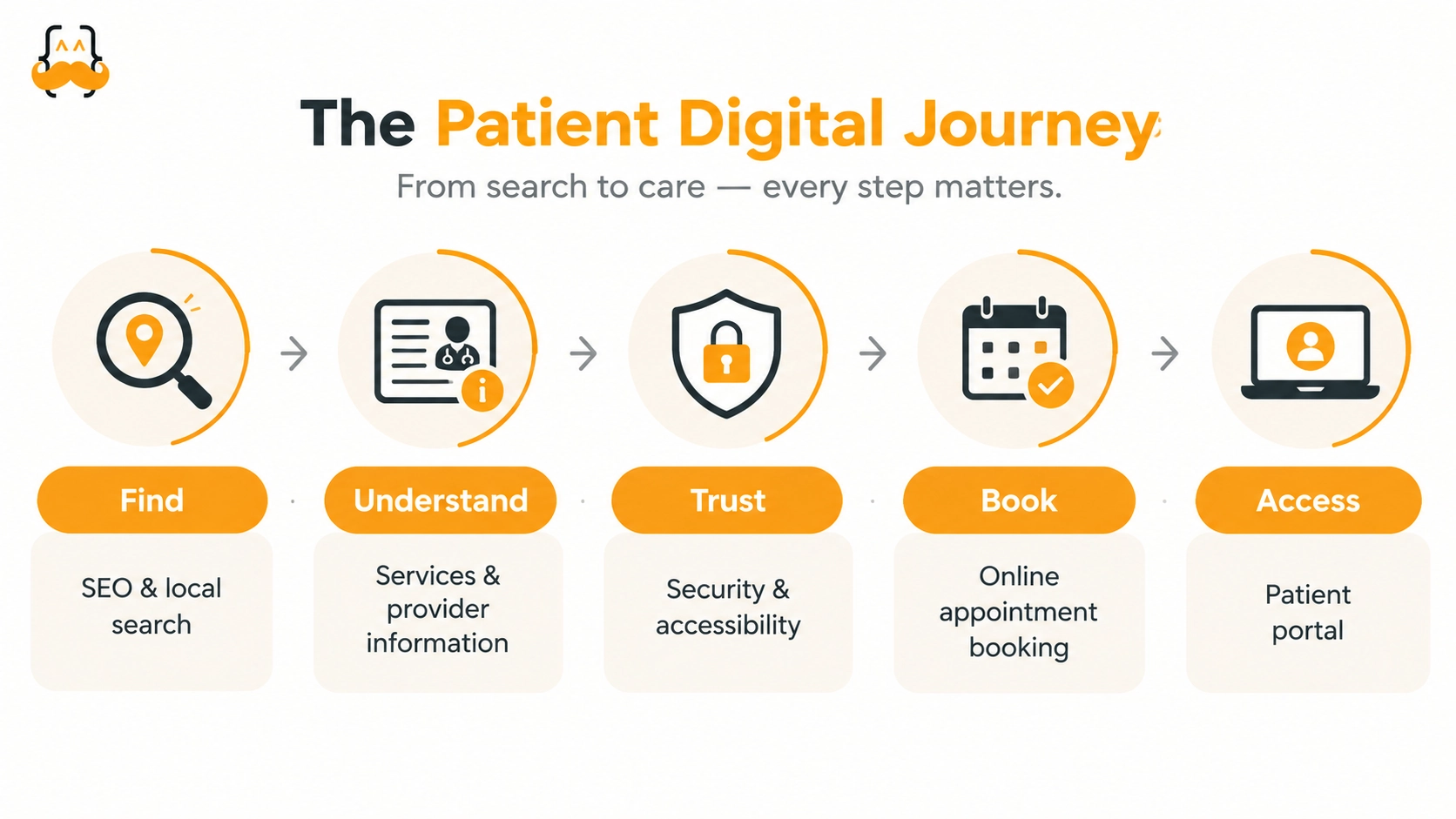
Patients increasingly expect healthcare organizations to provide useful digital experiences alongside traditional care.
A healthcare website should help a visitor move through a simple journey:
Find → Understand → Trust → Book → Access
Each stage depends on different parts of the website.
Good content helps patients understand their options. Provider information builds context. Accessible design makes information easier to use. Appointment booking provides a clear next step. Security protects sensitive interactions. SEO helps people discover the organization in the first place.
The result should be more than an attractive website. It should be a useful digital touchpoint within the broader patient journey.
Build a Healthcare Website Designed for Patients
A healthcare website should make everyday digital interactions feel straightforward.
Patients should be able to find the information they need, understand the services available, contact the organization, and complete relevant actions without unnecessary friction.
That means appointment booking should be simple, patient portals should be secure and usable, important information should be accessible, and the website should perform well across devices.
SEO should also be built into the website’s architecture and content from the beginning.
If your current healthcare website feels difficult to navigate, performs poorly on mobile, provides outdated information, or makes important services difficult to find, a redesign can be an opportunity to address the underlying experience rather than simply change the visual appearance.
Conclusion
In 2026, a healthcare website needs to do more than represent an organization online.
It should help patients find relevant information, understand available services, connect with healthcare professionals, and complete important actions with confidence.
The essential foundation includes online appointment booking, secure patient portals where appropriate, strong security, accessibility, responsive design, clear service and provider information, and SEO with local search optimization.
Each feature contributes to a different part of the patient journey.
The right approach will depend on the type of healthcare organization, its services, its technology environment, its audience, and its regulatory responsibilities. A small private practice may need a simpler digital setup than a multi-location hospital, while a healthcare provider handling electronic protected health information may have additional security and compliance considerations.
Ultimately, a healthcare website should make healthcare information and digital services easier to access.
FAQs
Online appointment booking, mobile-friendly design, accessibility, strong security, clear service information, patient portals, and SEO are key features.
Not necessarily. A patient portal is useful when the organization provides digital access to records, appointments, results, messages, or other patient services.
HIPAA applies to covered entities and business associates in the United States. Requirements depend on the organization and how patient information is handled.
Accessibility helps people with different abilities use the website, find information, complete forms, and access healthcare services more easily.
Patients often search for doctors, locations, services, and appointments from smartphones. A responsive website keeps these actions easy across different screen sizes.
Healthcare SEO helps people discover relevant services, doctors, and locations through search engines, while local SEO can improve visibility for nearby patients.

