
Contents
At a Glance
“How much does a healthcare website cost?” is usually the first question a clinic or hospital asks — and the honest answer is that it depends entirely on what the website needs to do. A single-doctor practice looking for a clean, trustworthy homepage has very different requirements from a multi-department hospital managing patient portals, integrations, and hundreds of pages of content.
Rather than chasing a single number, it helps to understand what actually drives the cost of a healthcare website — so you can budget for what your organization genuinely needs, instead of overpaying for features you won’t use or underpaying for ones you can’t do without.
A Quick Look at Website Complexity by Type
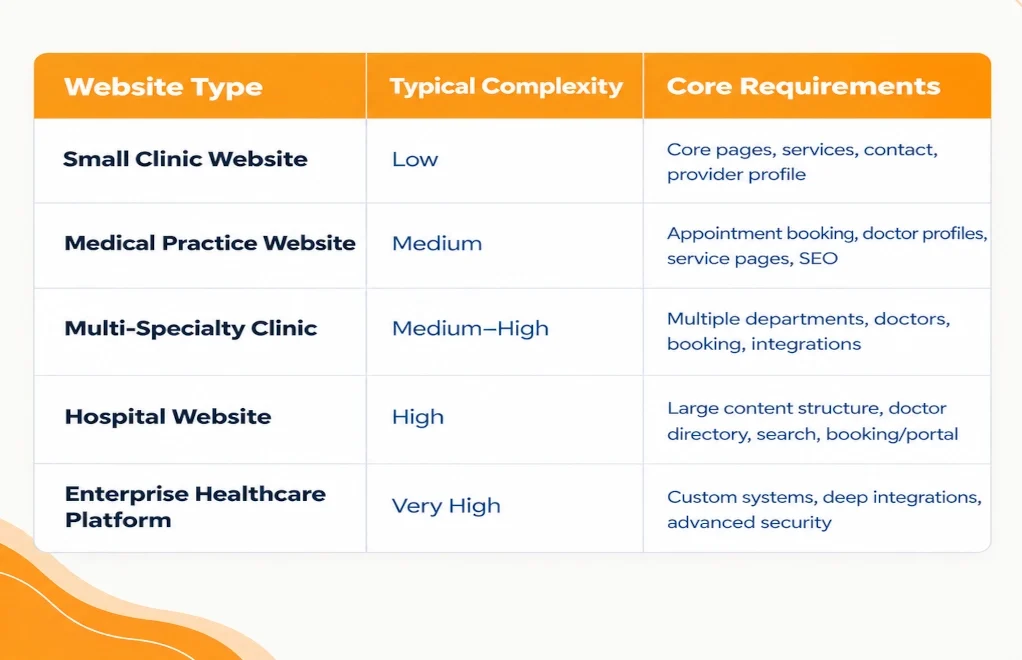
These categories are a starting point for thinking about scope — the real number still comes down to your specific requirements.
What Actually Drives the Cost
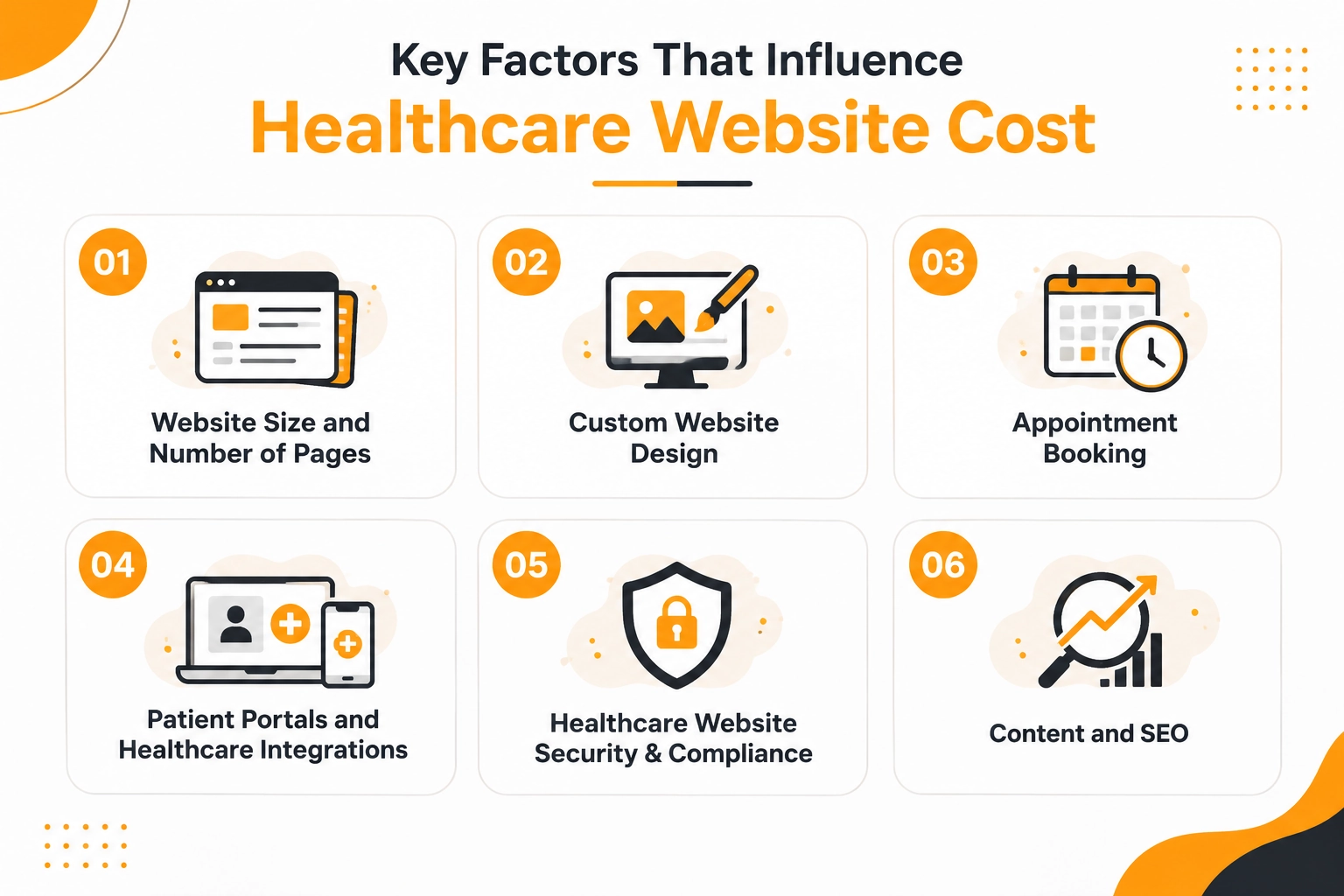
Website size and structure
A small clinic typically needs a home page, an about page, service listings, doctor profiles, and a contact and booking page. A hospital, by contrast, may need departments, treatment pages, condition pages, facility information, careers, and patient resources spread across hundreds of pages. More pages generally mean more planning and development time — though it’s worth noting that twenty highly customized pages can sometimes take more work than a hundred template-based ones.
Design depth
A template-based website is quicker and cheaper to launch, while a fully custom design — with a distinct visual identity, conversion-focused booking flows, and custom provider profile layouts — requires more research, wireframing, and revision. For healthcare specifically, design isn’t just about looking polished; it’s about making sure a patient can find information and take action without friction.
Appointment booking complexity
A simple link to a third-party scheduling tool is inexpensive to add. A fully custom booking system — with department and doctor selection, real-time availability, confirmations, and reminders — takes considerably more development effort, especially if it needs to sync with internal scheduling software.
Patient portal integration
Portals rarely store everything themselves; most connect to an existing EHR or practice management system. The cost here depends less on the portal’s visible features and more on the complexity of the systems it has to talk to, the authentication required, and the security architecture behind it.
System and API integrations
Every connection to an EHR, CRM, payment gateway, telehealth platform, or marketing tool adds its own development and testing requirements. It’s worth listing out exactly which systems your website needs to communicate with before requesting a quote — vague integration requirements are one of the most common causes of budget overruns.
Security and HIPAA considerations
If your website collects or transmits protected health information, expect additional work around encryption, access control, vendor agreements, and audit logging. For a deeper look at exactly what this involves, see our guide on HIPAA-Compliant Website Development for Clinics & Hospitals.
Accessibility
Keyboard navigation, screen-reader compatibility, color contrast, and accessible forms touch design, development, and content alike. Planning for accessibility from the start is considerably cheaper than retrofitting it after launch.
Content and copywriting
Service pages, doctor bios, condition pages, and blog content all need to be researched, written, and — in many cases — medically reviewed before they go live. This is often underestimated in early budget conversations, yet it’s one of the areas patients notice most.
SEO
Keyword research, metadata, heading structure, internal linking, and local search optimization are far easier to build in from day one than to retrofit onto an existing site structure later. We cover the specific features this supports in 7 Must-Have Features Every Healthcare Website Needs in 2026.
Performance
Image compression, efficient code, and attention to Core Web Vitals affect both how patients experience your site and how it ranks in search — neither of which forgives a slow-loading homepage.
Cost by Organization Type
A small clinic usually prioritizes clarity and conversion — a homepage, service pages, a doctor profile, appointment booking, and basic local SEO are often enough to start generating calls and bookings.
A private medical practice tends to need more depth: multiple service and specialty pages, a blog, testimonials, and stronger local SEO to compete for patients researching specific conditions or treatments.
A multi-specialty clinic adds real structural complexity — multiple departments and doctors, more advanced navigation, and often the first real need for a patient portal or healthcare system integration.
A hospital website sits at the top end of the scale, frequently running into hundreds of pages across departments, doctor directories, multiple locations, patient portals, multilingual content, and accessibility requirements that need to be planned for at an organizational level, not just a design level.
One-Time Costs vs. Ongoing Costs
It helps to separate what you pay once from what you pay continuously. One-time costs typically cover strategy, UX and UI design, development, content migration, initial SEO setup, integrations, and testing through to launch. Ongoing costs include hosting, security monitoring, software licenses, continued SEO and content work, and technical support.
A healthcare website is best thought of as a long-term asset rather than a one-time project — treating maintenance and security monitoring as optional add-ons rather than built-in costs is one of the most common budgeting mistakes clinics make.
What a Professional Quote Should Actually Include
When comparing proposals, look past the bottom-line number and check what’s actually covered — discovery and strategy, UX research and design, front-end development and CMS setup, content migration and copywriting, browser and accessibility testing, launch configuration, and a clear maintenance plan afterward. A lower quote that excludes several of these often ends up costing more once those gaps surface after launch.
Ways to Keep Costs Under Control
Reducing cost doesn’t have to mean choosing the cheapest bid. Prioritizing the features patients will actually use, using a well-planned design system with reusable components, preparing your content early so it doesn’t delay development, being selective about which integrations genuinely add value, and planning SEO from the start rather than retrofitting it — all of these narrow the budget without cutting corners on quality.
Choosing the Right Development Partner
The agency you choose affects the project as much as the budget does. It’s worth asking directly whether they’ve built healthcare websites before, how they approach accessibility and security, what their process looks like for integrations, and — importantly — what happens after launch. A development partner who can explain the reasoning behind their proposed scope, rather than just handing over a number, is usually the safer long-term choice.
FAQs
It depends on the website’s size, design complexity, functionality, integrations, security requirements, content, and ongoing maintenance needs — a small clinic site and a hospital platform sit at very different ends of that range.
Depending on scope, this can include strategy and UX/UI design, responsive development, CMS setup, content migration, appointment booking, integrations, SEO, accessibility, testing, and post-launch maintenance.
It often is, mainly because of healthcare-specific requirements like patient portals, security architecture, and accessibility — though the actual difference comes down to project scope rather than the industry itself.
Usually, yes. Compliance affects hosting, encryption, vendor agreements, and testing, all of which add development time compared to a standard business website.
Not always — some agencies include a short post-launch support window, while ongoing maintenance is billed separately. It’s worth confirming this explicitly before signing off on a proposal.
A small clinic site can often launch in a few weeks, while a hospital website with custom integrations and hundreds of pages typically takes several months of planning and development.

