
Contents
- 1. At a Glance
- 2. Introduction
- 3. Easy Online Appointment Booking
- 4. Secure Patient Portals
- 5. HIPAA Compliance and Strong Security
- 6. Accessible Healthcare Website Design
- 7. Mobile-First and Responsive Design
- 8. Clear Healthcare Services and Provider Information
- 9. Fast Performance, SEO, and Local Search Optimization
- 10. Why These Healthcare Website Features Matter in 2026
- 11. Build a Healthcare Website Designed for Patients
- 12. Conclusion
- 13. FAQs
At a Glance
- Online Appointment Booking – Facilitate easy and quick booking of appointments for patients
- Secure Patient Portals – Offer patients a convenient way to access their appointment, medical records, test results, and messages with the practice
- Strong Security Measures – Ensure the security of patients’ data and privacy while complying with healthcare regulations and laws
- Accessibility – Design the website in a way that is easily navigated and used by all individuals
- Mobile Responsiveness – Make the website easily accessible and functional across all devices and platforms
- Information About Services and Providers – Help patients find information about the services offered and the professionals they will deal with
- Search Engine Optimization – Ensure the website is easily found and functions well when searched on a search engine and is local-friendly
Introduction
Healthcare website is no more a simple online brochure for clinics and medical practices. Today patients expect healthcare websites to make it easy for them to find information, book appointments, access services, communicate and navigate care from any device.
Besides, healthcare websites have to be private, secure, accessible, efficient and compliant.
If you are developing a new medical website or thinking about redesigning an existing one, keep in mind that the right features will help to provide excellent patient experience and build your organization’s credibility online. Here are 7 healthcare website features that your practice should have in 2026.
Easy Online Appointment Booking
Among the most important functions of a modern healthcare website is the ability to book appointments via modern technologies. For example, patients will not want to call to schedule or change appointments during office hours. The booking system should be optimized to help website visitors:
- Book appointments
- Find out which doctors and healthcare providers are available
- Choose a desired service or appointment type
- Provide personal information
- Get booking confirmation
- Reschedule or cancel appointments
Moreover, the appointment booking system should be optimized for mobile devices as a significant part of Internet users access websites via smartphones and tablets.
A complicated booking system will actually drive customers away — the more steps to complete a booking, the less patients will want to use the system. By optimizing the appointment booking process, you will get more customers and increase conversion.
Secure Patient Portals
More and more patients are demanding convenient digital access to their health data.
A patient portal can offer you a reliable solution in the form of secure access to medical records, labs, appointments, prescriptions, billing information, secure messaging, healthcare-related documents and much more.
Such software is typically designed with a seamless integration in mind that will ensure patient data privacy while providing a convenient experience for your customers on the website. The solution should also be intuitive and prioritize convenience and readability. A portal that is easy to navigate and offers responsive design and convenient login forms can save your patients precious time and effort.
As for your own staff, the convenience lies in the fact that portals usually require minimal clerical support, reducing the burden on healthcare professionals in terms of administrative work.
HIPAA Compliance and Strong Security
The data handled by your website is highly sensitive, meaning that you need to think about HIPAA compliance and data security during the early stages of the development cycle.
If your entity is subject to HIPAA laws, the website and any other system you utilize needs to be designed with the relevant standards in mind. Depending on the nature of your practice, there are several HIPAA-compliant website requirements you might need to consider.
Depending on the website and services offered, important considerations may include:
- HIPAA-compliant data transmission;
- Access control and encryption;
- HIPAA-compliant login and authentication;
- Protection of patient data and forms;
- HIPAA-compliant portals and document exchanges;
- System and network security;
- Security monitoring and maintenance.
One thing to note is that simply having a privacy policy or a self-posted HIPAA compliance statement is not enough to ensure the protection of your patients’ data.
You are encouraged to consult with a professional to determine what you personally are required to do in order to be HIPAA compliant. Healthcare websites should also consider HIPAA-compliant website development and maintenance options throughout the development cycle – not during the launch or maintenance phase.
Accessible Healthcare Website Design
Accessibility is the second key characteristic of modern healthcare website. Such sites have to be designed to accommodate as many people as possible, including those with physical, sensory, or cognitive challenges. There are several features that should be included when creating an accessible healthcare website. These include
- clear heading titles,
- adequate different color contrast,
- accessibility Keyboard,
- alternative text for meaningful images,
- labels for all fields in a healthcare website,
- captions or transcripts for pertinent multimedia,
- readable text size,
- sensible error messages
and structuring pages in a way that is easy to navigate. Finally, it is critical to adopt widely recognized standards in website accessibility, such as the Web Content Accessibility Guidelines. This will ensure that the content is as accessible to as many people as possible. It is especially important to make sure that the website is accessible to those who are at the greatest risk of being unable to use it for an extended period.
Mobile-First and Responsive Design
Patients often use their smartphones to search for a doctor, study directions, look for the clinic hours, research available treatments, or set up an appointment. Thus, a healthcare website should be designed in a way that would make it easy for patients to perform these actions and get the information they need in the most convenient way. The features that provide such functionality and are easy to implement are the following:
- Big buttons
- Easy-to-read font size
- A simple navigation system
- Fast loading of the pages
- Short and simple forms
- Accessibility of such functions as calling, directions, and setting up an appointment
An adequate responsive design and user interface that will suit all kinds of devices and be comfortable for every patient.
Clear Healthcare Services and Provider Information
Patients want to know what services your facility offers and who can provide them before they contact you in need of care. So your website must be informative and attractive so that the target audience can find the information they are looking for. Here is a list of suggested web pages for your reference:
- Medical services
- Treatments and procedures
- Doctors and specialists
- Conditions treated
- Locations
- Insurance and payment
- Office hours
- Frequently asked questions
You can create informative web pages about providers with their qualifications, field of specialty, areas of expertise, education, certifications, and other relevant information. Having this information on your website can help the target audience make well-informed decisions while providing search engines with an opportunity to crawl and index your content to rank your website higher in SERPs. For instance, instead of putting all services on one page, create dedicated pages for each to make the information easily scannable by both users and search engines.
Fast Performance, SEO, and Local Search Optimization
A beautiful healthcare website is a work of art only if patients can actually find it and if they can navigate it easily. So, your healthcare website strategy needs to include SEO and performance from the start. The critical components critical to your SEO healthcare website checklist include:
- Fast, optimized page speed
- Images that are optimized
- Website architecture that is easily navigated
- Descriptive page titles and meta descriptions
- Internal website links
- Mobile-friendly design
- Schema structure
- Well-structured content
- SEO-friendly URLs
- Local SEO
- Correct healthcare business information
- Healthcare sites that target a local audience can benefit substantially from local SEO.
Make sure the information on your site, including organization name, address, phone number, services, and hours, is correct and consistent with other directories that list your company. In addition, you may want to create content that targets the types of questions your patients are searching for.
Why These Healthcare Website Features Matter in 2026
Patients are increasingly seeking to manage some aspects of their healthcare online. Frequently, the website will be the first point of call for many patients.
As such, it is important that the website offers more than an aesthetically pleasing experience.
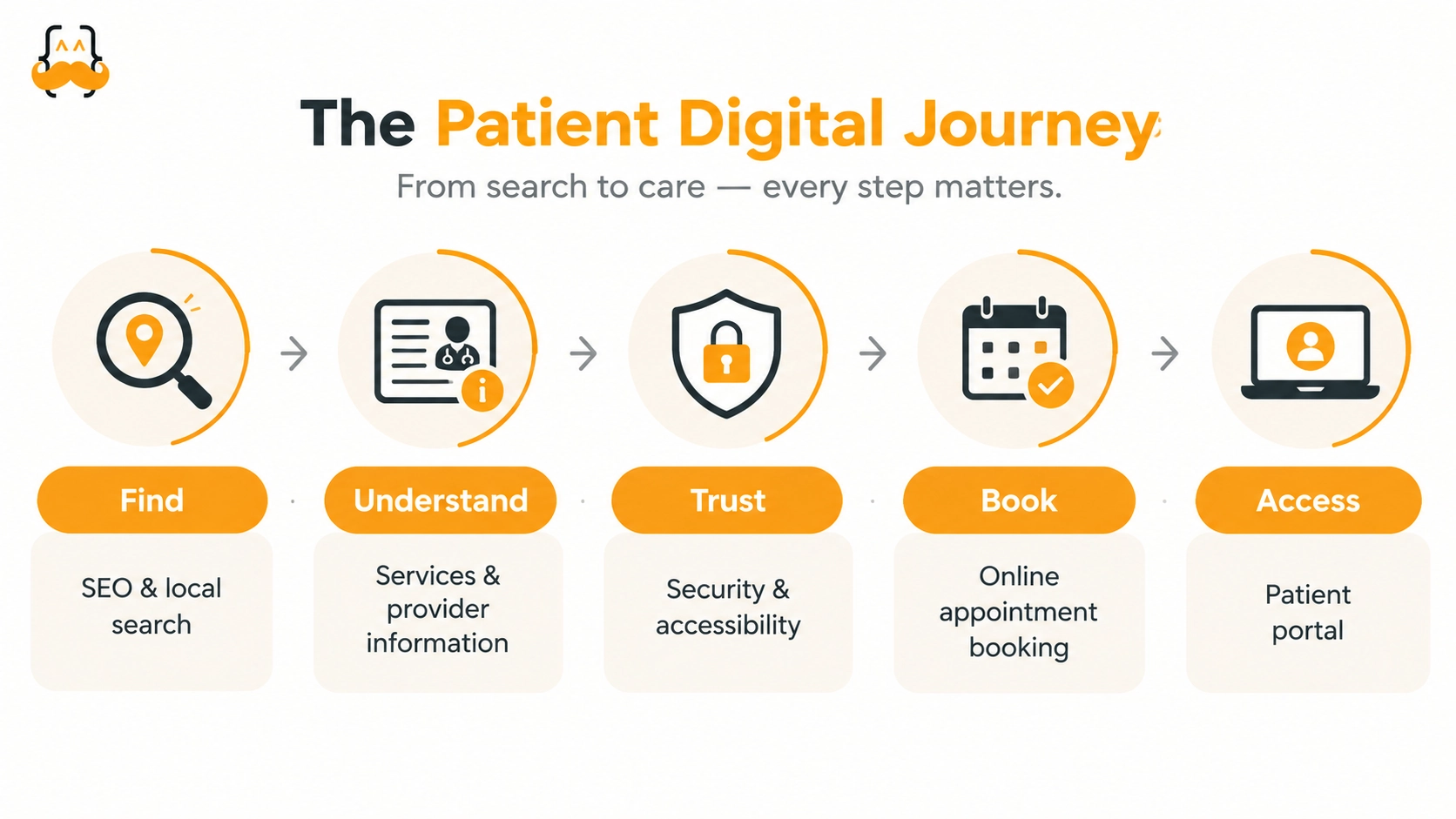
A successful healthcare website will enable patients to:
Find → Understand → Trust → Book → Access
his can be achieved through a combination of design and functionality, accessibility and security, content and context, performance and convenience, and digital services. When done right, the website can offer an integrated experience that supports the wider patient journey, rather than just a brochure or business card.
Build a Healthcare Website Designed for Patients
Your healthcare company’s website needs to be optimized to provide patients with a seamless experience online scheduling, patient portal access, and other available services are critical components that must be user-friendly. The website should be accessible to everyone, including those with disabilities, and safe and secure. Healthcare practice websites must also be mobile responsive, SEO optimized, and fast.
Therefore, if your organization’s website is not attracting the desired attention, is hard to navigate or does not have the required features, it might be time to redesign it. A well-designed healthcare company website will offer patients what they need: easy access to the practice and its services.
Conclusion
In 2026, the healthcare website is a vital element in providing high-quality care. The website should be designed to serve the convenience of the patients, provide credible information, ensure safety and reliability, be up-to-date, optimized for mobile devices, offer relevant services, and be easy to use.
Each of these points is worth consideration when looking for the best healthcare website builder. Organizing the booking system, setting up a patient portal, ensuring data security and accessibility, implementing responsive design, optimizing for search engines, offering services, and asking for feedback are the factors that cannot be neglected.
After all, the ultimate goal of creating a website for healthcare should be serving patients by providing them with the information they need, helping them choose the right services, instilling confidence in the quality of care, and facilitating the booking process.
At the same time, a healthcare website will help the clinic become known to the target audience and build authority through the provision of quality content. Therefore, if your website misses critical elements to be user-friendly, contemporary, and convenient in 2026, it is time to consider redevelopment to fulfill the expectations of your patients. In 2026, the healthcare website should not only represent your business but also care for the patients throughout the entire appointment process.
FAQs
The healthcare website should be built in a way that allows patients to easily manage information and navigate through the services offered. Such a site should include online booking, patient portals, security, mobile responsiveness, accessibility, provider directories, and content.
I think that websites offering online appointment booking will allow patients to book an appointment easily without calling during working hours. It is necessary to create a simple interface, optimize for mobile devices, and take care of security.
A patient portal on a healthcare website is a secure portal offering patients the ability to access various services, such as booking, receiving and storing test results, reviewing bills, and having encrypted communication with the staff. Everything depends on what the organization’s portal offers patients.
Organizations need to understand their scope and responsibilities when handling protected health information. While each healthcare organization is HIPAA compliant, it does not mean that the website is secure and complies with the regulations. The organization must turn to specialists who will ensure that the website and its features meet the standards.
The importance of making the healthcare website more accessible is that it will provide care to more patients since it will be optimized for those with special needs. It is required to make the website’s navigation more accessible by using alternative texts on images, readable fonts, sufficient color, contrast, and special forms.
The healthcare website should contain relevant and quality content that will attract more patients. The website should also have optimized headings, title tags, URL structure, internal links, page speed, mobile-friendliness, and local SEO.
A healthcare organization should not set a deadline for website development and redesigning. Redesigning should be done if the website started to slow down, became more challenging to use, outdated, insecure, inaccessible, or ineffective.
There are several differences in design, including the need for privacy, security, accessibility, and trust. In addition, depending on the type of healthcare organization, other features may be required on the website, such as booking, portal, medical directory, and applications for communication.

