
Contents
- 1. Key takeaways
- 2. Introduction
- 3. Is the Indian IT Job Market Really Shrinking?
- 4. The Side Under Pressure: Execution-Based IT Jobs
- 5. The Side That's Growing: AI, Cloud, Data and Judgment
- 6. How GCCs Are Changing India's IT Job Market
- 7. What This Shift Means for IT Professionals
- 8. What It Means for SEO and Digital Marketing Professionals
- 9. The Future of Indian IT Jobs: From Headcount to Capability
- 10. Final conclusion
- 11. FAQs
Key takeaways
- Indian IT jobs are not disappearing overall; the mix of work is changing.
- Revenue is growing faster than headcount because AI raises output per person.
- Repetitive, process-driven roles face the most pressure, especially for professionals with 3 to 8 years of experience.
- AI, cloud, data and judgment-based roles are growing, and GCCs are a major source of these jobs.
- The safest career strategy is combining AI skills with domain knowledge and moving from task execution to decision-making.
Introduction
The Indian IT job market is not collapsing, and it is not business as usual either. It is splitting in two. On one side are execution-based roles, such as manual testing, routine support, standard coding and report generation, where AI now does more of the work and companies hire fewer people for it. On the other side are roles built on AI, cloud, data and judgment, where demand is growing faster than the supply of skilled people.
The numbers show both halves at once. According to Nasscom, India’s technology industry grew revenue by 6.1% to about $315 billion in FY26, while headcount grew only 2.3% to roughly 5.95 million. In the same year, the five largest IT services firms reduced their combined workforce, while global companies kept opening Global Capability Centres (GCCs) in Bengaluru, Hyderabad, Pune and beyond.
This guide explains what is shrinking, what is growing, how GCCs are changing hiring, and what IT, SEO and digital marketing professionals should do next.
Is the Indian IT Job Market Really Shrinking?
No. Total employment in the Indian IT job market is still growing slowly, but hiring for traditional execution work is falling while hiring for AI, cloud, data and specialist roles is rising.
The current IT job market
FY26 was a turning point for Indian IT jobs. The top five IT services companies (TCS, Infosys, Wipro, HCLTech and Tech Mahindra) together cut 6,981 jobs, reversing two years of headcount growth. TCS alone ended March 2026 with 584,519 employees, down from 607,979 a year earlier.
Yet the wider industry still added around 1.4 lakh people, taking total employment to nearly 59 lakh. Large firms also continue campus hiring, with TCS planning around 40,000 fresher hires. The difference is that these offers increasingly go to candidates with AI, cloud and digital skills rather than general engineering profiles.
The overall impact of AI
For three decades, Indian IT followed a simple formula: revenue equals people multiplied by hours multiplied by billing rate. To grow revenue, companies hired more people. AI has weakened that link. When a coding assistant writes boilerplate, an AI agent runs regression tests and a model triages support tickets, a company can deliver the same project with a smaller team.
Nasscom leadership publicly acknowledged this gap between revenue growth and employment growth in early 2026. That gap is the clearest sign of AI’s impact on Indian IT jobs.
"Shrinking" vs "changing" job market
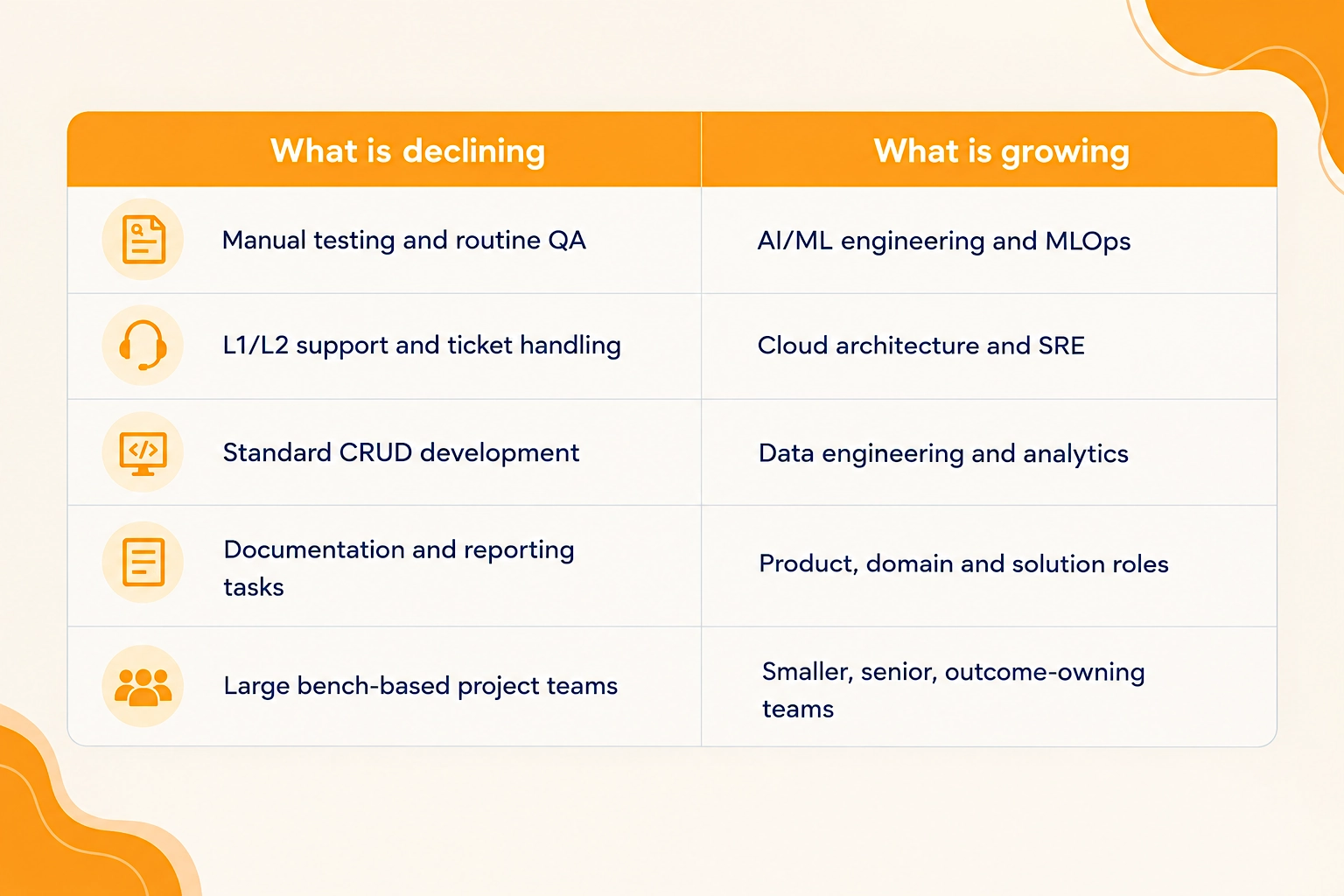
Calling the market “shrinking” misses half the story. A more accurate description is a market that is changing shape.
The Side Under Pressure: Execution-Based IT Jobs
IT jobs most affected by AI are those built on repeatable, rules-based tasks that can be clearly specified, checked and automated.
Repetitive and process-driven work
Execution-based roles follow a known process with predictable inputs and outputs. Typical examples include:
- Writing and running manual test cases
- Monitoring dashboards and escalating alerts
- Resetting passwords, access requests and basic troubleshooting
- Converting clear requirements into standard code modules
- Preparing routine reports, documentation and migration scripts
This work was the base of the traditional IT services pyramid. Large numbers of engineers handled it under a smaller layer of leads and managers.
AI automation
AI tools now handle a large share of these tasks. Coding assistants generate and review code, AI testing tools create and maintain test suites, and support bots resolve common tickets without human involvement. Infosys said in its FY26 annual report that work is moving away from writing code toward orchestrating systems, supervising AI, interpreting domain needs and validating outcomes.
The work still exists. It simply needs fewer people to complete it.
Why traditional roles are facing pressure
Three forces are pushing on execution-based roles at the same time:
- Client expectations: Global clients know AI raises productivity and expect those savings in lower contract prices.
- Pricing models: Fixed-price and outcome-based contracts reward vendors that use fewer people, not more.
- Tooling maturity: AI tools have moved from experiments to standard parts of delivery pipelines.
As a result, companies now focus on utilisation and productivity instead of adding headcount for every new deal.
Impact on the 3–8 years experience group
Professionals with 3 to 8 years of experience face the sharpest squeeze. Freshers are cheaper and, with AI tools, can handle much of the routine work. Senior people own architecture, client relationships and decisions. The middle layer, often reliable executors who have not yet taken ownership of design or business outcomes, is the easiest to compress.
Reports on TCS’s 2026 workforce reductions noted that cuts fell mostly on middle and senior grades. For this group, the path forward is to move quickly toward system design, domain depth or AI-enabled delivery leadership.
The Side That's Growing: AI, Cloud, Data and Judgment
AI jobs in India, along with cloud, data and judgment-based roles, are growing because companies need people who can build, run and make decisions about AI-powered systems.
AI-related roles
Demand for AI skills is rising faster than supply. Bain & Company estimates India could have about 2.3 million AI job openings by 2027, against roughly 1.2 million qualified specialists. AI skills in demand include:
- Machine learning and deep learning engineering
- Generative AI application development and LLM integration
- MLOps and model deployment
- AI agents and workflow automation
- AI governance, safety and evaluation
Surveys also report a salary premium of roughly 20% to 38% for AI skills, though these figures are self-reported and vary by role.
Cloud and data jobs
AI depends on clean data and reliable infrastructure. That keeps demand strong for cloud architects, site reliability engineers, DevSecOps specialists, data engineers and analytics professionals. Every AI project needs data pipelines, security, cost control and monitoring, and those skills sit firmly on the growing side of the split.
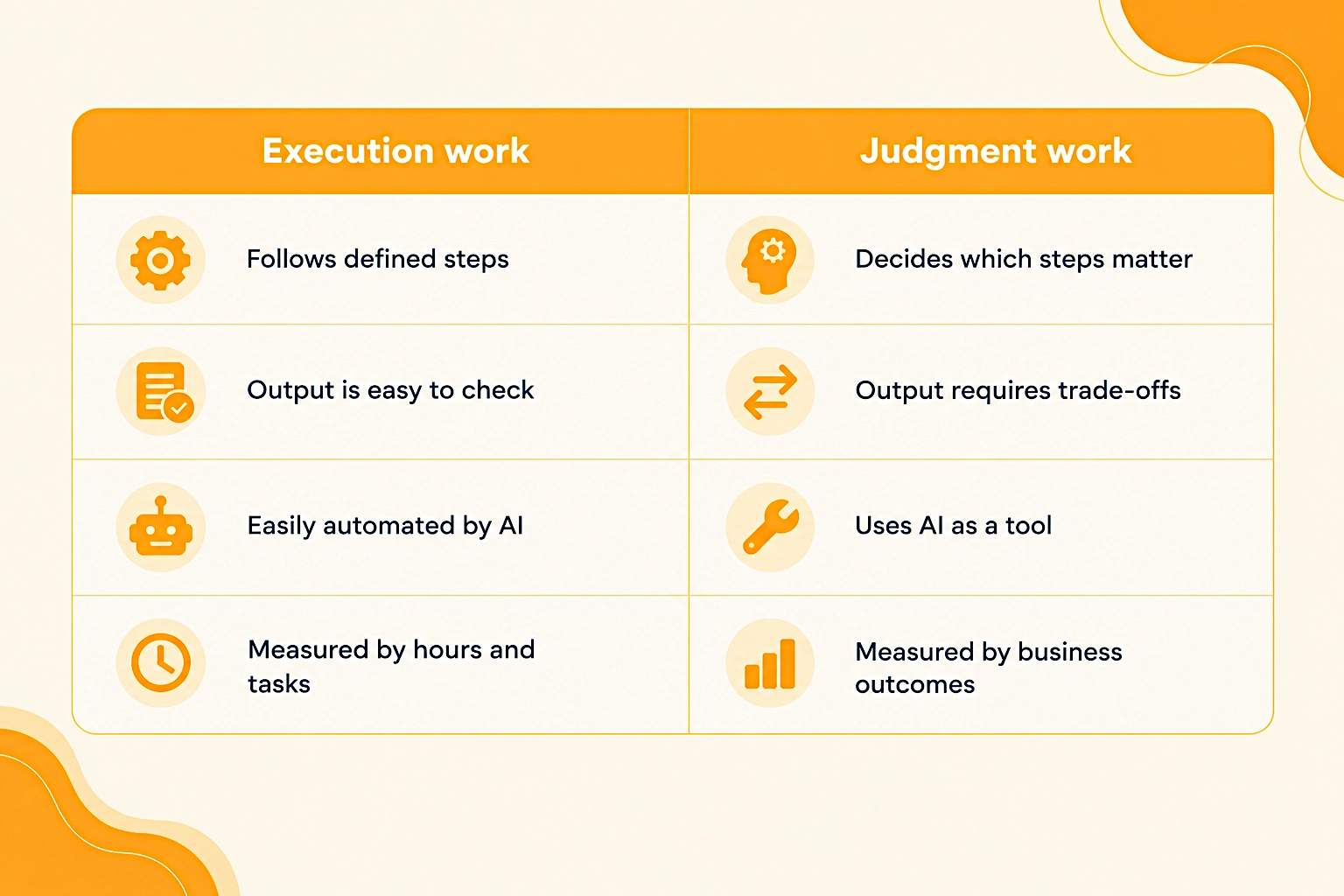
Execution vs judgment
The clearest way to see the split is the difference between execution and judgment.
Why problem-solving skills are becoming valuable
AI can produce answers quickly, but someone still has to frame the right question, judge whether the answer is correct and decide what to do with it. Professionals who can diagnose a business problem, choose the right approach and take responsibility for results are becoming more valuable because AI makes execution cheap and good judgment scarce.
How GCCs Are Changing India's IT Job Market
GCCs are creating a large share of higher-value IT jobs in India because global companies now build their own engineering, AI and product teams here instead of relying only on outsourcing vendors.
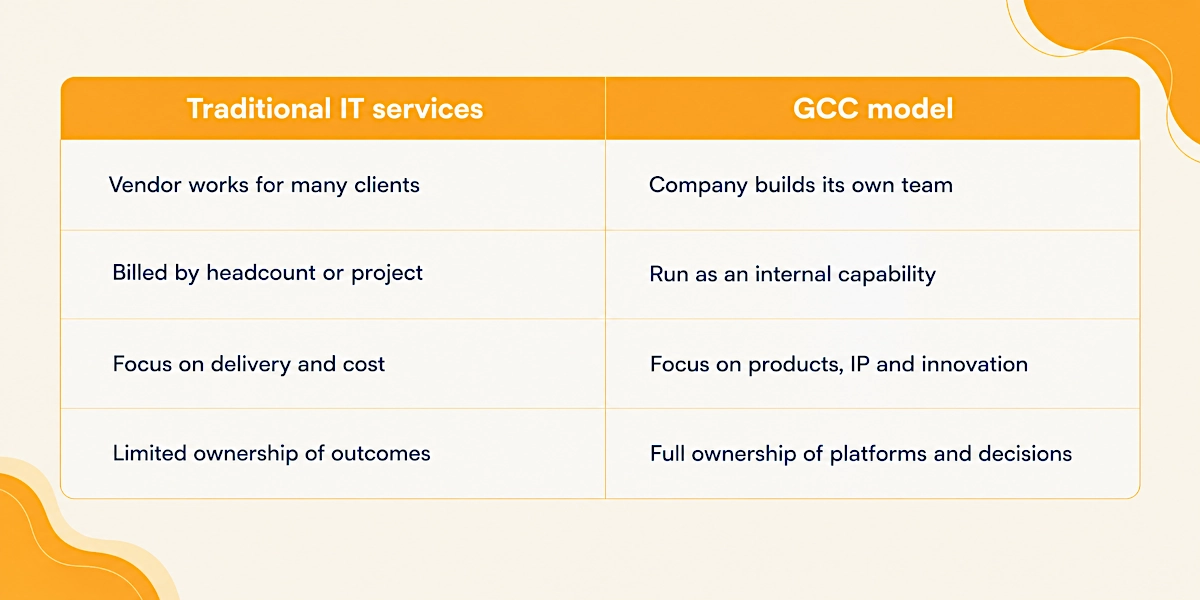
What are GCCs?
A Global Capability Centre (GCC) is an offshore unit fully owned by a multinational company. It performs core business functions such as engineering, product development, analytics, AI, finance and operations for the parent company.
Traditional IT services vs GCC model
Why companies are building teams directly in India
Companies choose India for its large talent pool, cost advantage and time-zone coverage. They also want direct control over intellectual property, security and product roadmaps. As AI becomes central to business strategy, many firms prefer to keep that capability in-house rather than outsource it.
Higher-value roles and changing hiring patterns
GCC hiring in India is growing fast. The Nasscom–Zinnov GCC Landscape 2026 counts 2,117 GCCs in India, employing over 2 million professionals, with employment projected to reach around 2.8 million by 2030. According to JLL, GCCs accounted for 38% of office leasing in India’s top seven cities in 2025.
GCC jobs in India differ from traditional services roles. Most new centres prioritise AI, data, product and platform engineering. They tend to hire experienced professionals with domain knowledge, and more of them are opening in Tier-2 cities such as Jaipur, Coimbatore, Indore and Kochi, where costs are lower and talent is available.
What This Shift Means for IT Professionals
IT professionals need to move from doing tasks to solving problems, and from single technical skills to a mix of AI, domain knowledge and business thinking.
Skills that are becoming less valuable
- Manual testing without automation skills
- Knowledge of one tool or framework in isolation
- Routine coding from detailed specifications
- Basic reporting and documentation
- Rule-based support work
These skills still help, but they no longer set you apart.
Skills professionals should develop
The most useful future IT skills are:
- AI fluency: using AI coding, testing and analysis tools every day
- Cloud and data: AWS, Azure or GCP, data pipelines and analytics
- System design: architecture, integration and security thinking
- Communication: explaining trade-offs to business stakeholders
- Product thinking: understanding users, metrics and outcomes
AI + domain expertise
The strongest combination is AI skills plus deep knowledge of one industry, such as banking, healthcare, retail, insurance or manufacturing. A developer who understands lending rules and can build an AI credit-risk workflow is far harder to replace than a generalist coder. Domain knowledge tells you which problems are worth solving, and AI skills let you solve them faster.
Moving from task execution to decision-making
To make this move in practice:
- Volunteer for work that involves design, estimation or client discussion.
- Use AI tools to finish routine tasks faster, then spend the saved time on higher-level work.
- Learn how your project creates business value, not only how the code works.
- Build a visible portfolio of problems you solved, not only tickets you closed.
What It Means for SEO and Digital Marketing Professionals
AI in digital marketing is automating routine SEO tasks, so professionals who focus on strategy, AI search visibility, analytics and conversions will grow while pure execution roles shrink.
AI impact on SEO
The AI impact on SEO follows the same pattern as IT. AI tools can now write content briefs, generate meta tags, cluster keywords and run technical audits in minutes. At the same time, AI Overviews, ChatGPT and Perplexity answer many questions directly, which reduces clicks for purely informational searches.
From keyword execution to strategy
Old SEO work often meant targeting keywords, publishing content and building links at volume. That kind of execution is now cheap. The value has moved to strategy: choosing which topics support business goals, building real topical authority and creating content that shows first-hand experience AI cannot copy.
Analytics, AI Search, AEO/GEO, CRO and business understanding
The growing skill set for SEO and digital marketing professionals includes:
- AEO (Answer Engine Optimization): structuring content so AI assistants and search features can extract clear, direct answers.
- GEO (Generative Engine Optimization): earning citations and brand mentions inside AI-generated responses.
Analytics: connecting traffic to leads, revenue and customer lifetime value. - CRO (Conversion Rate Optimization): turning existing traffic into more enquiries and sales.
- Business understanding: knowing how the client makes money and what growth means for them.
Why SEO professionals need to become problem solvers
Clients do not really want rankings; they want customers. SEO professionals who diagnose why a business is not growing online, whether the issue is positioning, content, technical health, conversions or AI visibility, will stay in demand. Those who only deliver task lists will compete directly with AI tools.
The Future of Indian IT Jobs: From Headcount to Capability
The future of IT jobs in India will be defined by capability, not headcount. Companies will win with smaller, AI-enabled teams that deliver measurable business value.
Reskilling and continuous learning
Large employers are already investing heavily in reskilling. TCS reported that more than 270,000 of its associates had higher-order AI and ML skills by March 2026. For individuals, learning is now a continuous habit, not a one-time certification. A useful rule is to spend a few hours every week learning one skill that moves you closer to judgment-based work.
AI as a productivity tool
The professionals who do best will treat AI as a teammate, not a threat. Using AI for drafting, coding, testing and research frees time for design, communication and decision-making, the parts of the job AI cannot own.
Shift from billing for headcount to delivering business value
The future of Indian IT depends on moving from selling hours to selling outcomes. Companies are shifting toward outcome-based and platform-led pricing, where clients pay for results such as faster releases, lower costs or higher conversions. This rewards firms and professionals who understand the client’s business, not just the technology.
Final conclusion
Indian IT jobs are splitting into two paths. One path, built on repetitive execution, is shrinking as AI takes over routine tasks. The other, built on AI, cloud, data, domain expertise and judgment, is growing through both IT services firms and GCCs. The market is not closing its doors; it is raising the bar. Professionals who upgrade their skills, pair AI with domain knowledge and take ownership of outcomes will find more opportunity in the next decade of Indian IT, not less.
FAQs
AI is reducing demand for repetitive IT roles such as manual testing and routine support, but overall IT employment in India is still growing slowly. New jobs are appearing in AI, cloud, data and GCCs.
The IT jobs most affected by AI are manual testing, L1/L2 support, routine coding, documentation and reporting roles, because these tasks are repeatable and easy to automate.
The most in-demand AI skills in India include machine learning, generative AI and LLM integration, MLOps, data engineering, AI agents and cloud platforms such as AWS, Azure and GCP.
A GCC is an offshore centre owned by a multinational company. GCC hiring in India is growing because companies want direct control over AI, product and engineering work while using India’s large talent pool.
They should move beyond task execution by learning AI tools, building cloud or data skills, developing domain expertise and taking ownership of design, client communication and business outcomes.
Yes, but the role is changing. SEO professionals who add AEO, GEO, analytics, CRO and business strategy skills will stay in demand, while purely execution-based SEO work will decline.

